
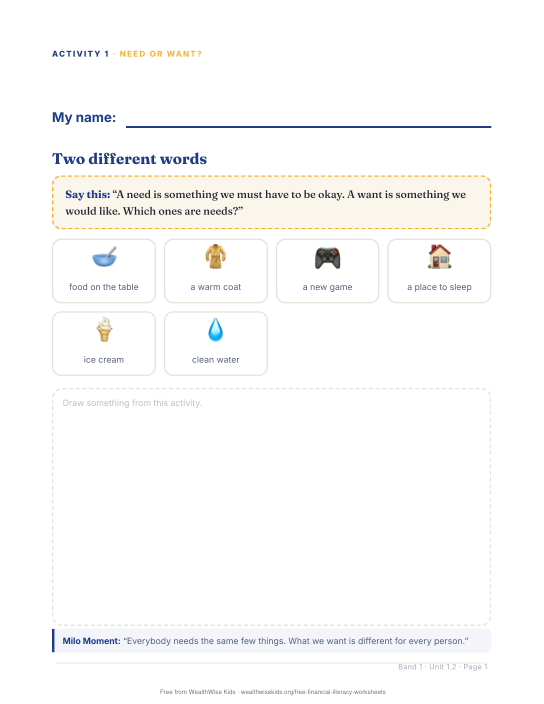
Need or Want?
Six everyday things to sort into needs and wants, then one of each to draw. It's where money starts for a young child: two different words, and knowing which is which.
Free · Printable · With answers
35 free printable financial literacy worksheets for kids and students, covering every grade band, each a one-page PDF with an answer page. No sign-up and no email. They are real activities from our K–12 curriculum, not a teaser written for the web.
No account. No email. Nothing collected about your child.

35 free worksheets
Six everyday things to sort into needs and wants, then one of each to draw. It's where money starts for a young child: two different words, and knowing which is which.
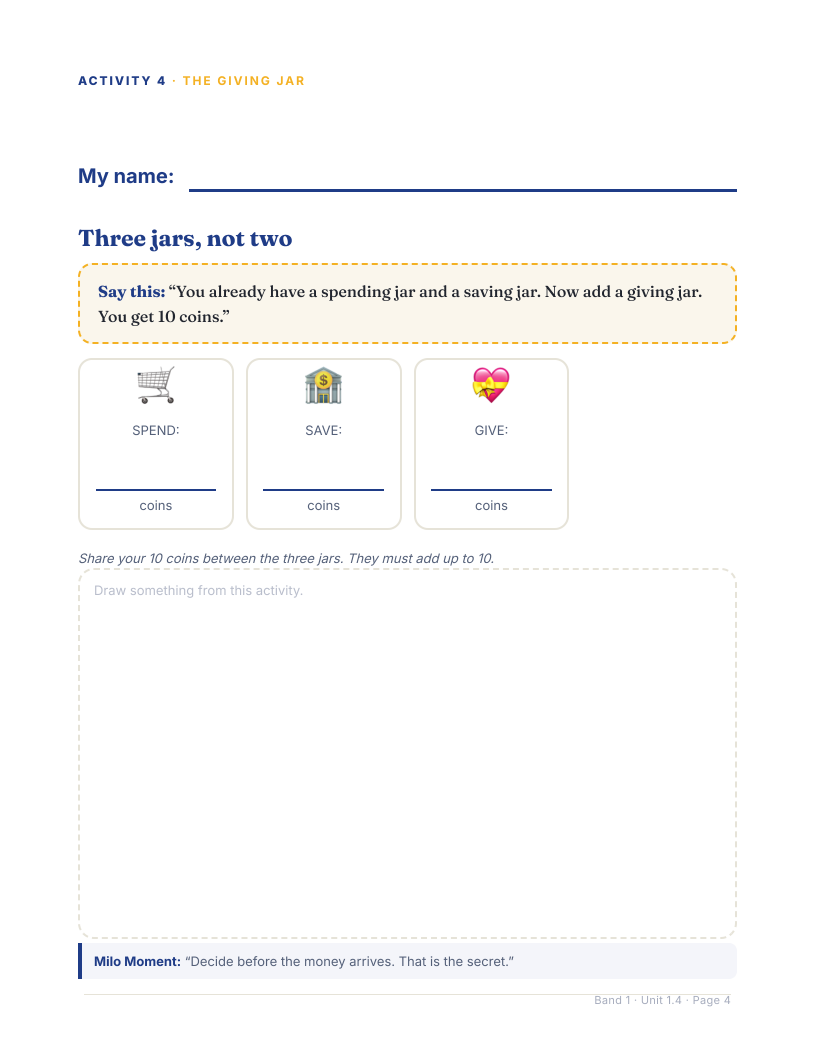
Ten coins, three jars — spend, save and give. Split them however you like, as long as they add up to ten, then say why.
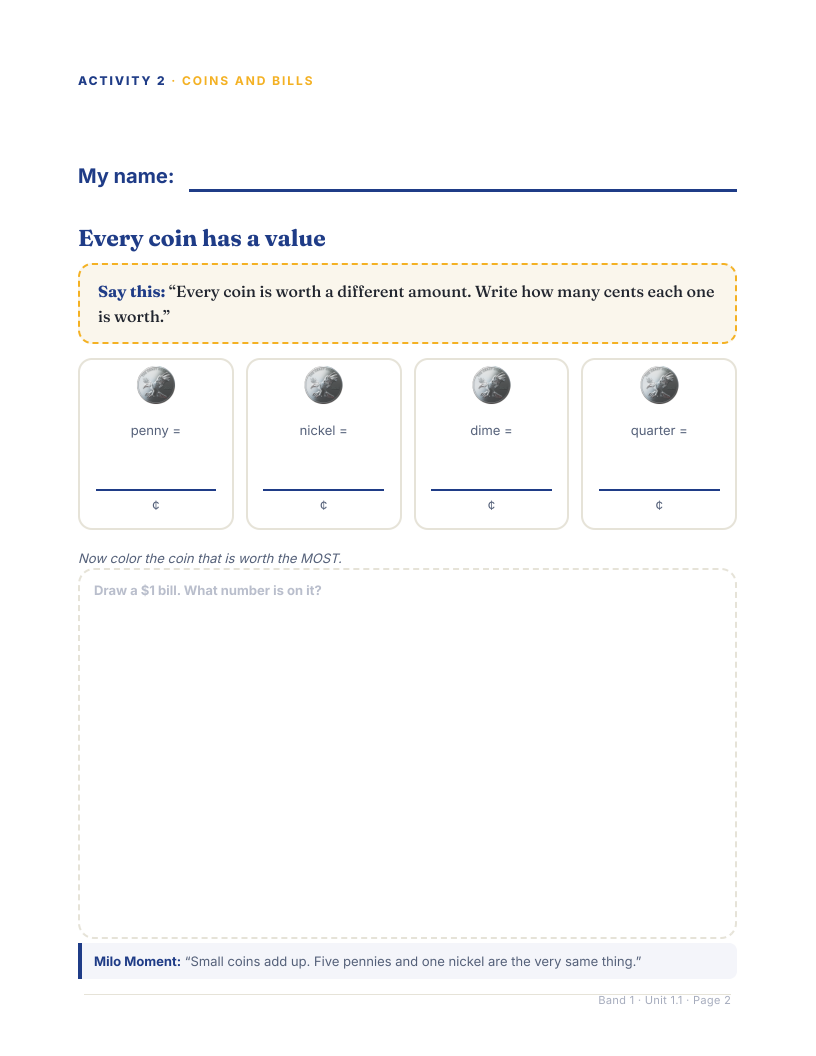
Write what a penny, nickel, dime and quarter are each worth, color the one worth the most, then draw a dollar bill and find the number on it.
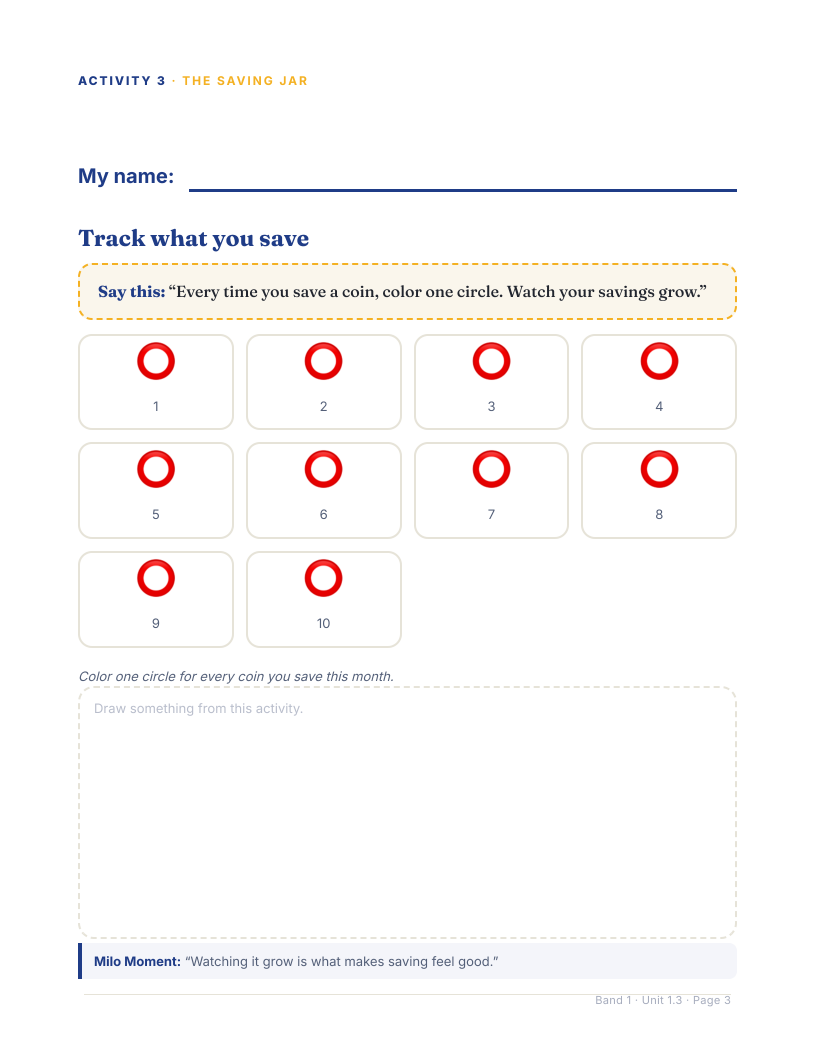
Ten circles. Color one in every time you save a coin, and watch a month of saving turn into something you can see.
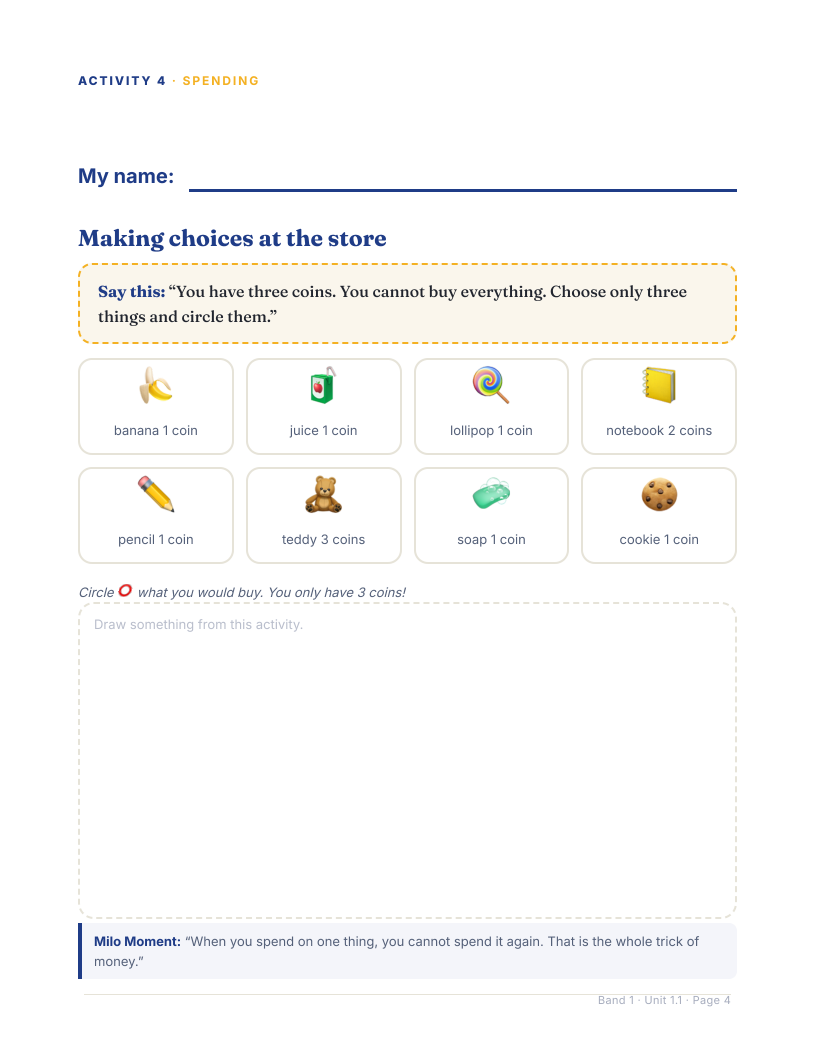
Three coins and eight things on the shelf, priced one to three coins. Circle what you would buy — and find out that the teddy costs everything.
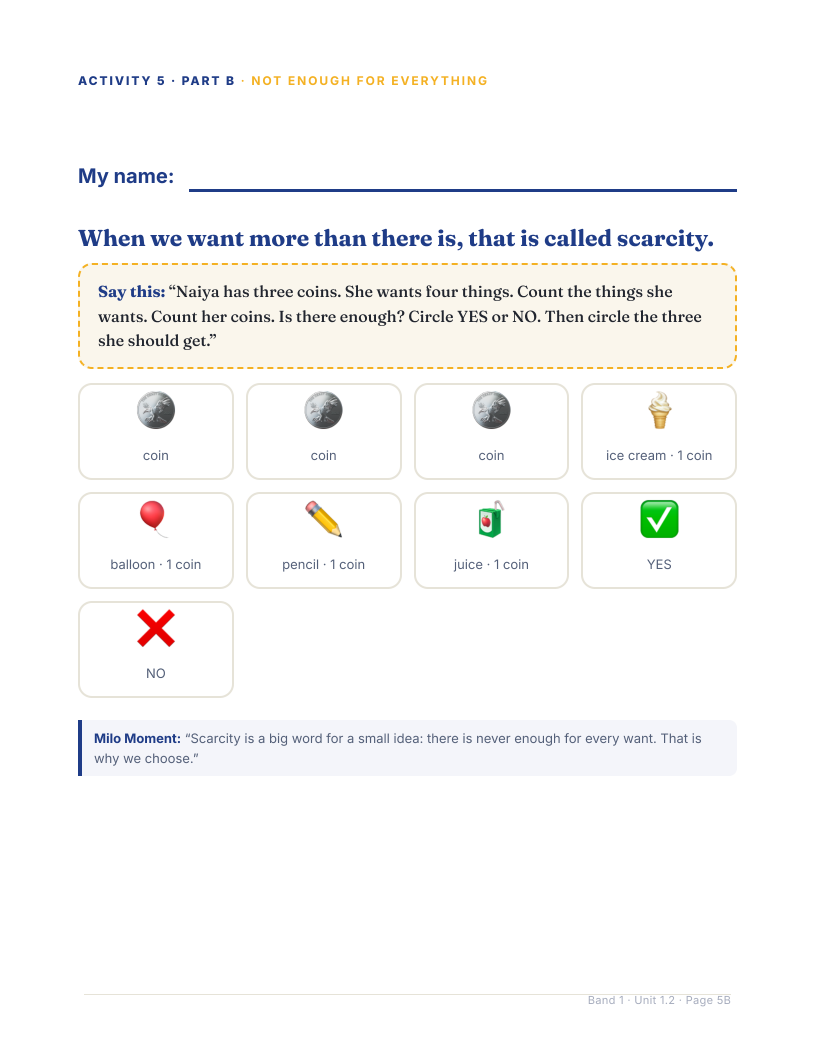
Naiya has three coins and wants four things. Count both, decide whether there is enough, then choose which three she should get.
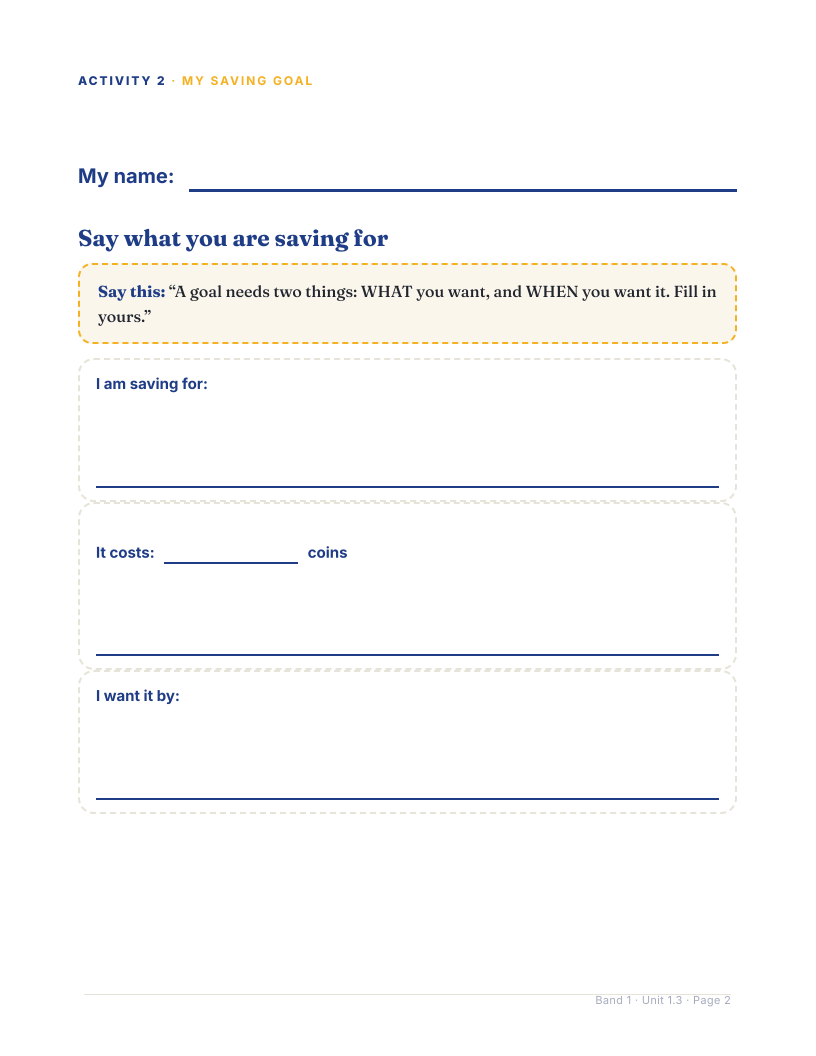
Name one thing you are saving for, what it costs, and when you want it by. A goal a child can say out loud is a goal they can keep.
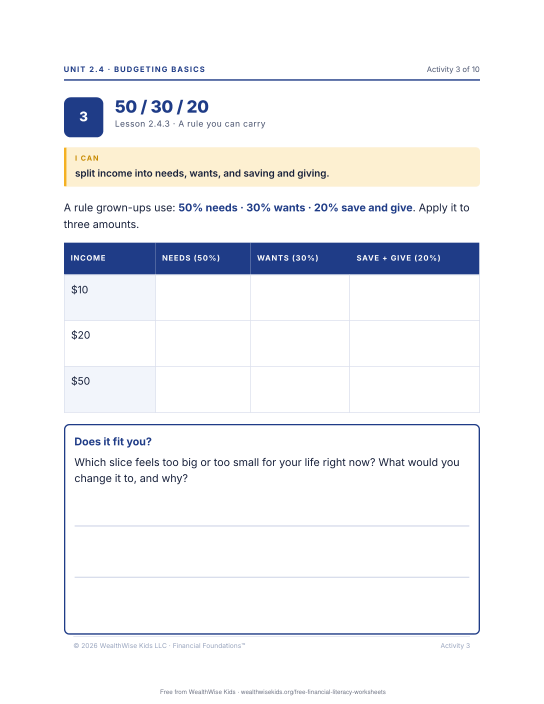
A first budget. Split $10, $20 and $50 into needs, wants, and save-and-give, then decide whether the rule fits your own life and what you would change.
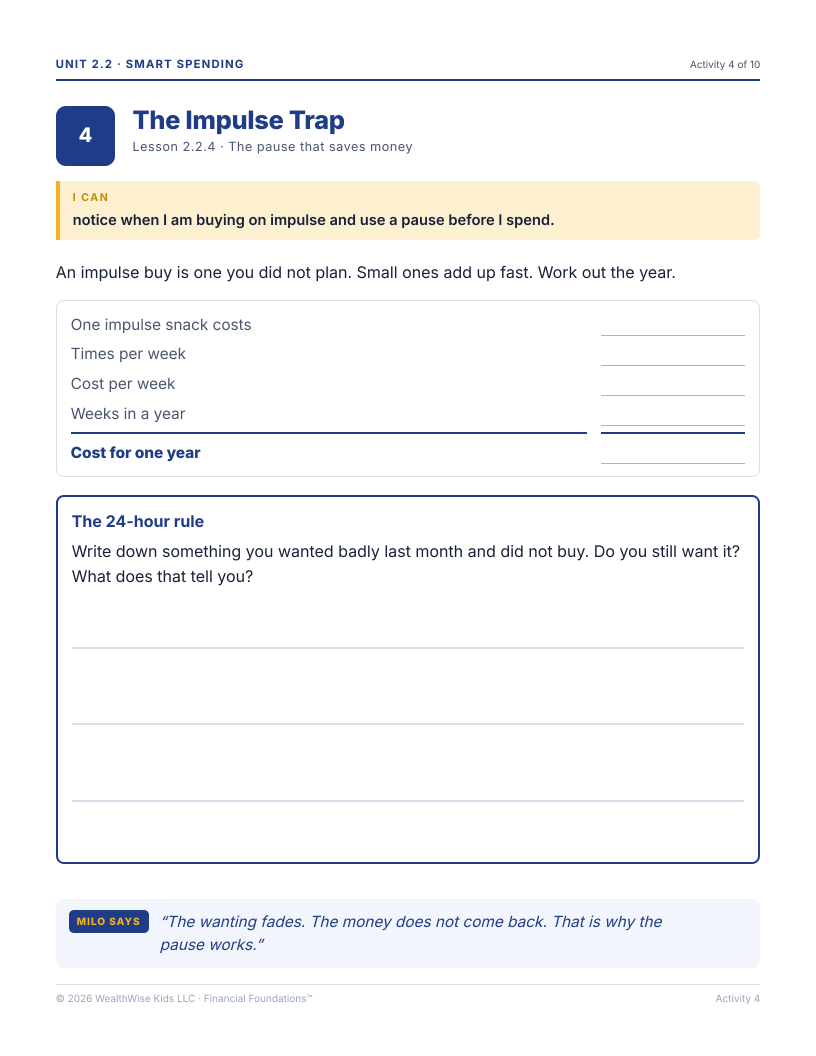
Take one small thing you buy without planning, multiply it out across a year, and then try the 24-hour rule on something you wanted last month.
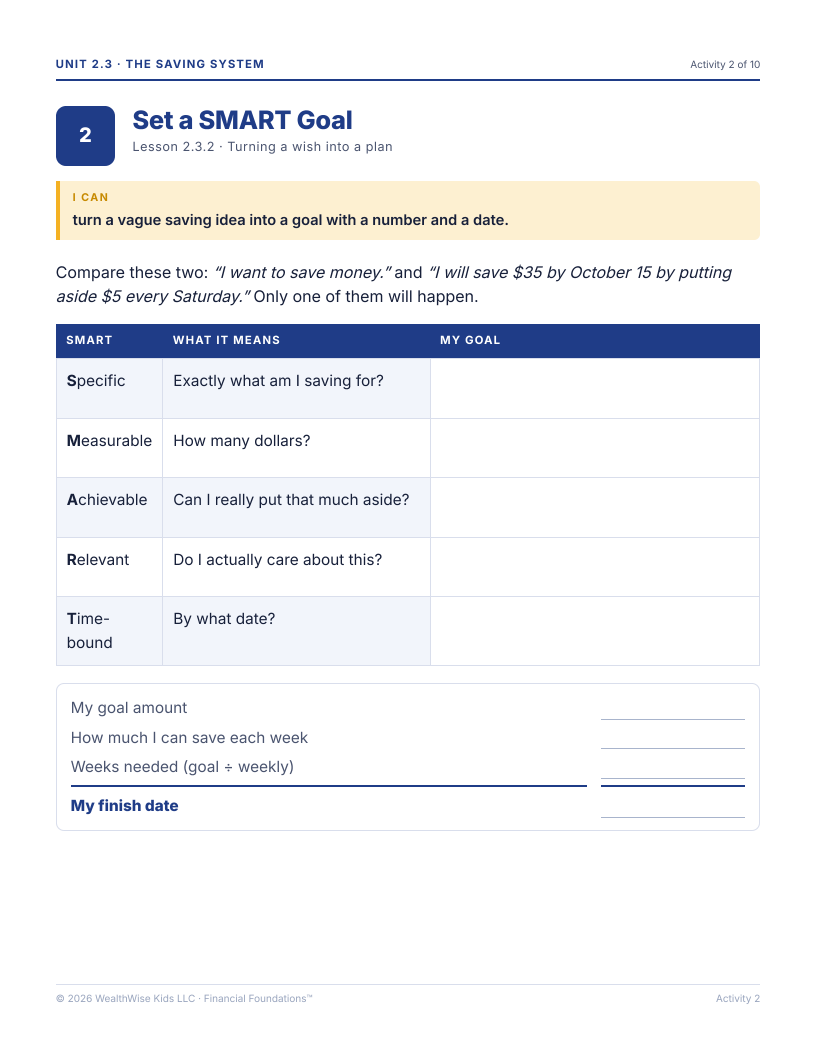
Turn “I want to save money” into a goal with a number and a date, then work out how many weeks it takes and when you will finish.
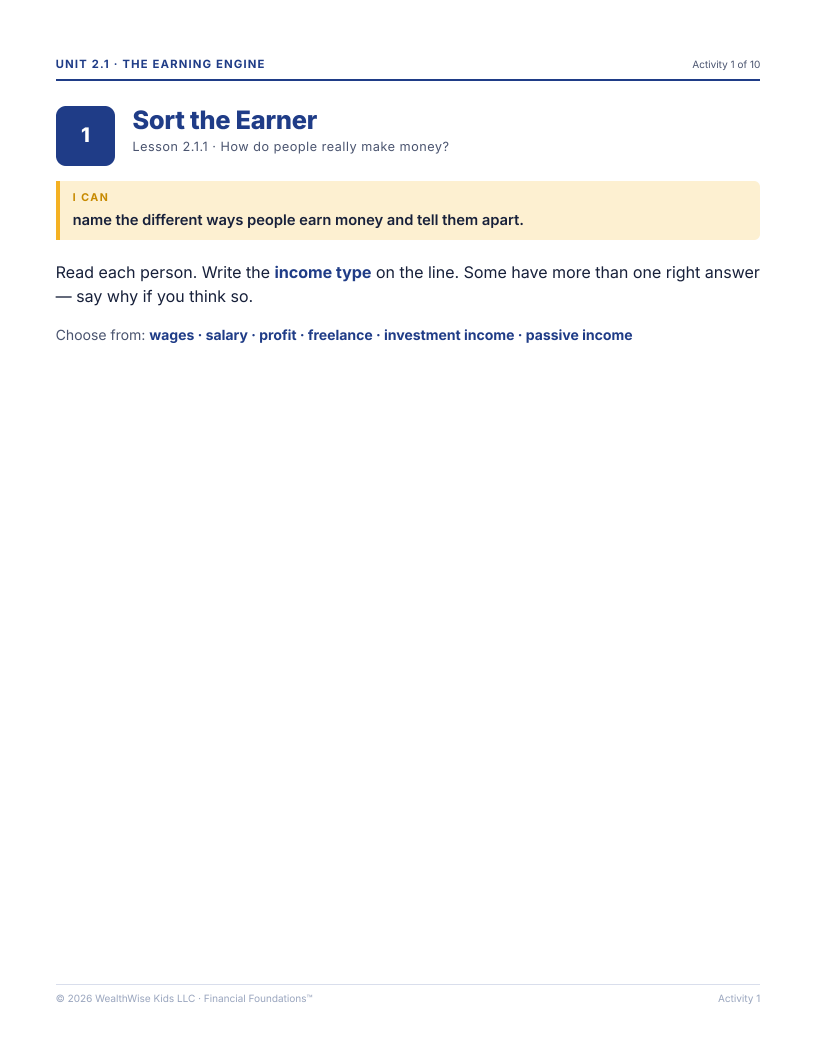
Eight people, eight ways of getting paid. Read each one and name the income type — wages, salary, profit, freelance, investment or passive.
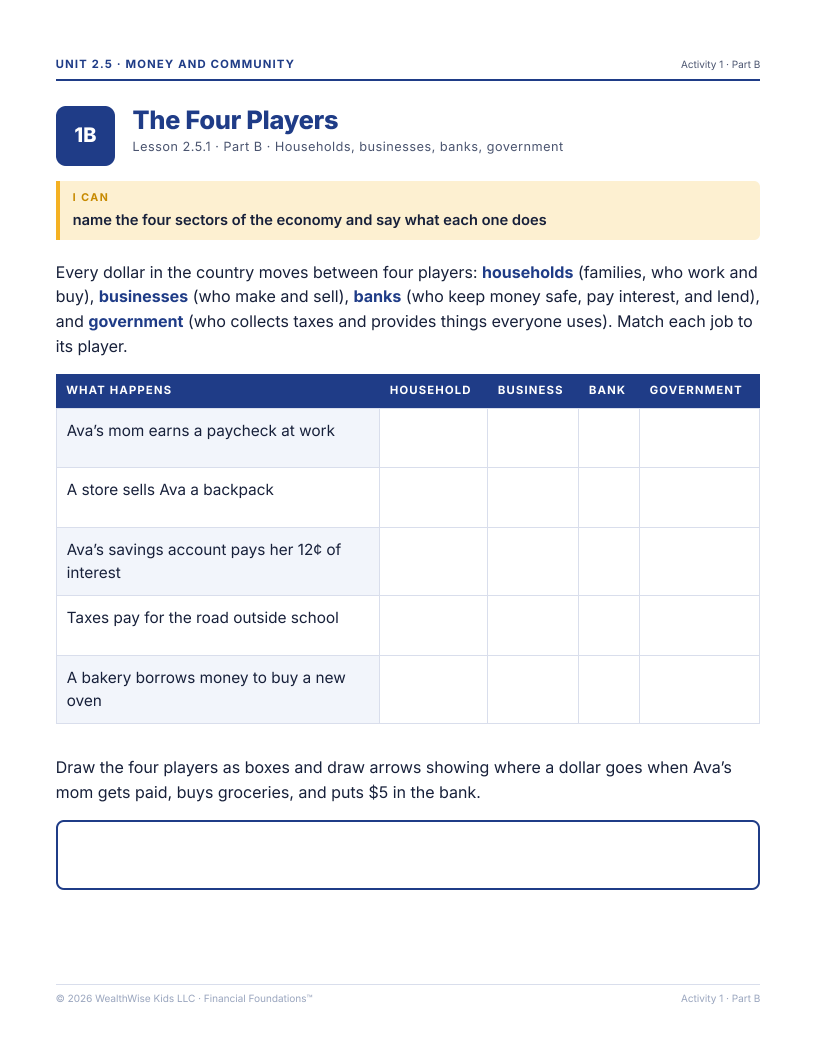
Households, businesses, banks and government. Match five everyday events to the player behind each, then draw where a dollar actually goes.
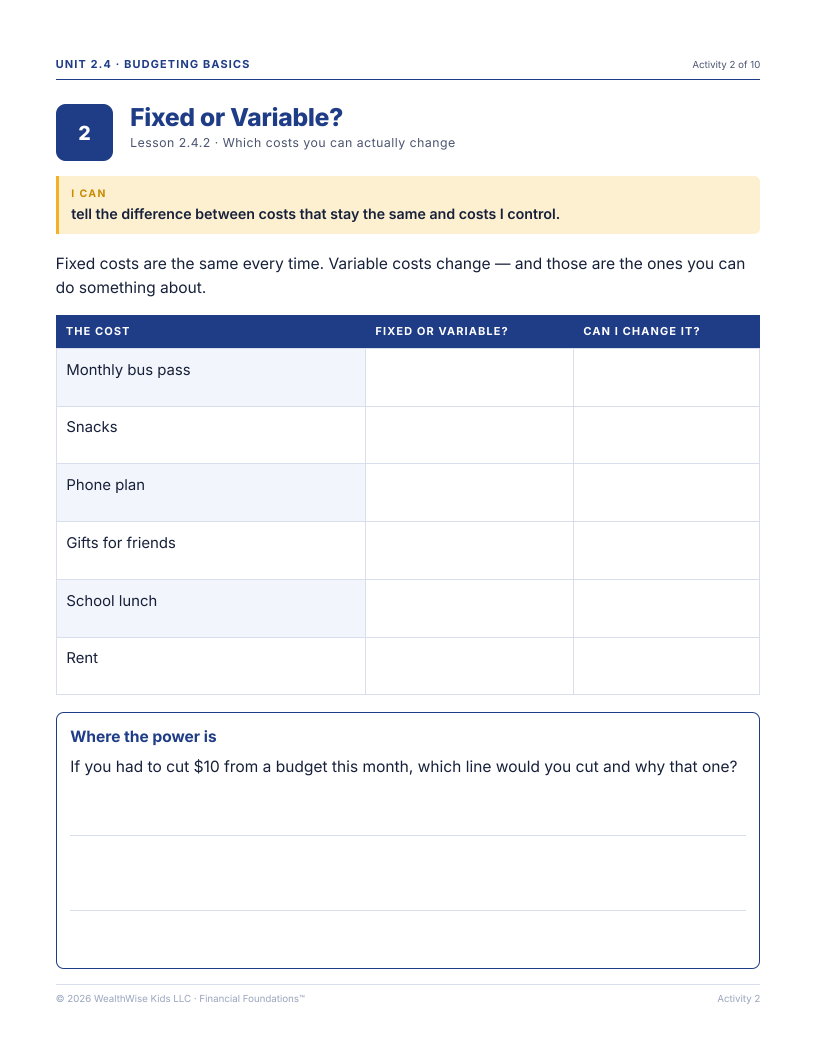
Six real costs. Sort each into fixed or variable, say whether you could actually change it, then pick the one you would cut.
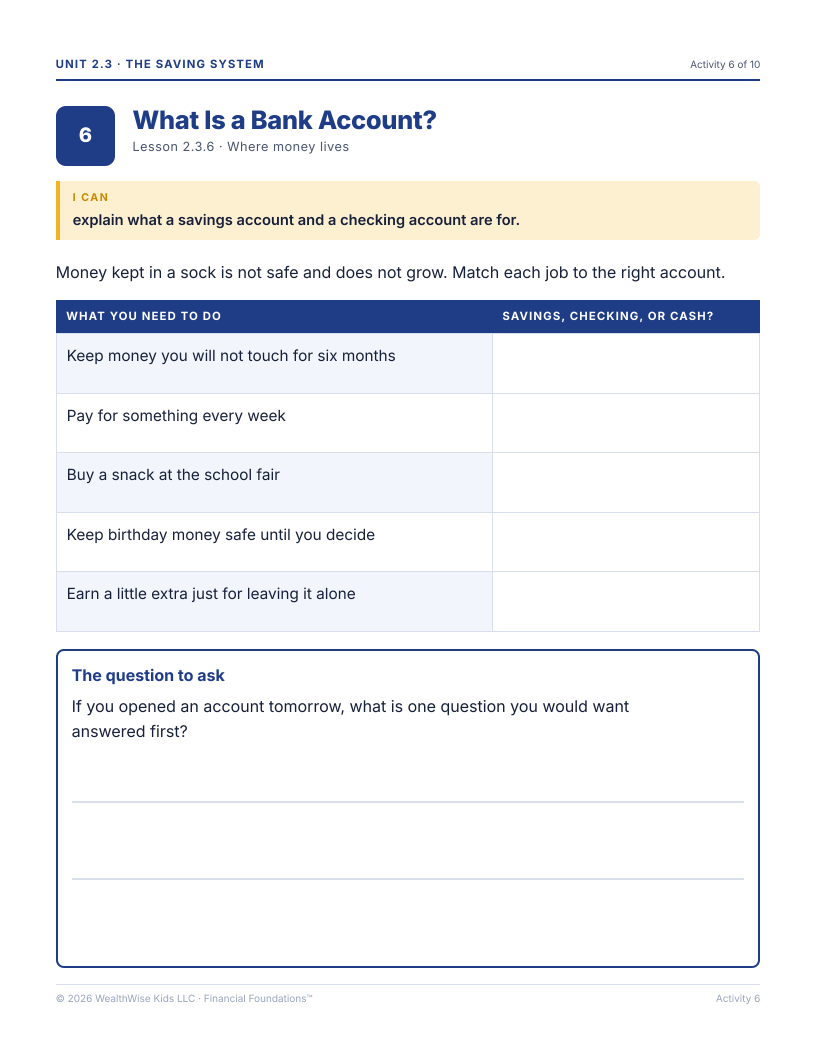
Five everyday jobs for money. For each one, decide whether it belongs in savings, in checking, or in cash.
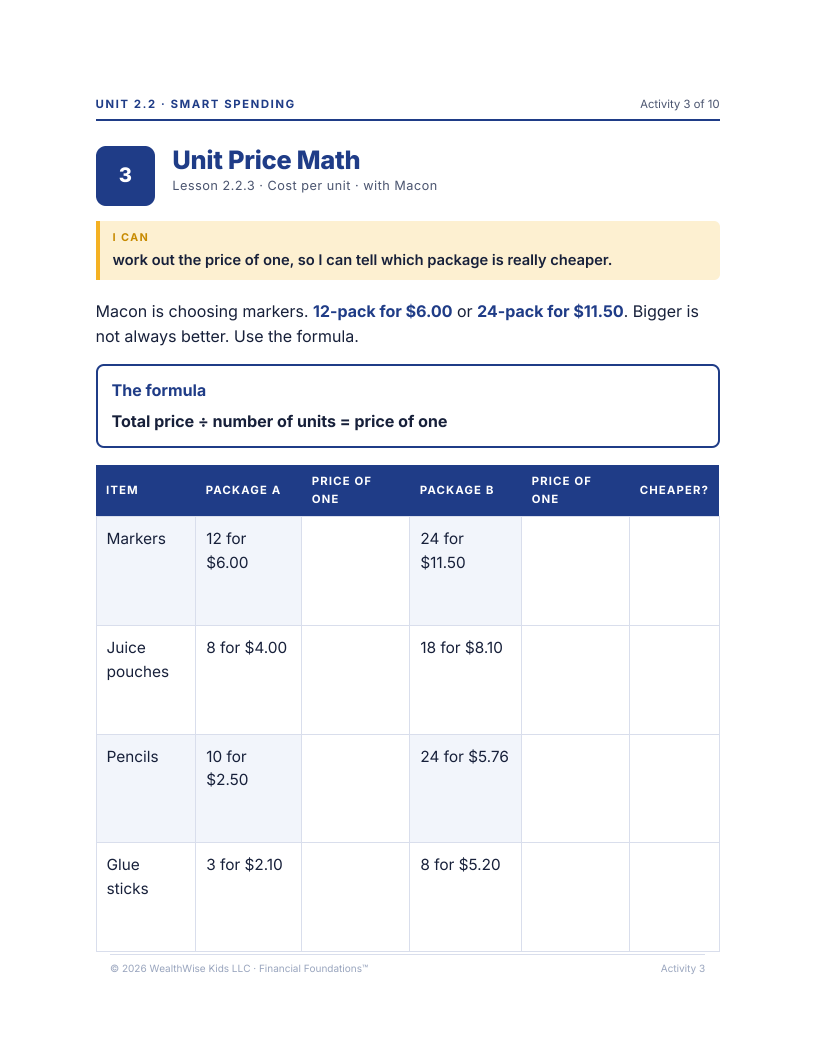
Four pairs of packages — markers, juice, pencils, glue sticks. Work out the price of one in each, then say which package is really cheaper.
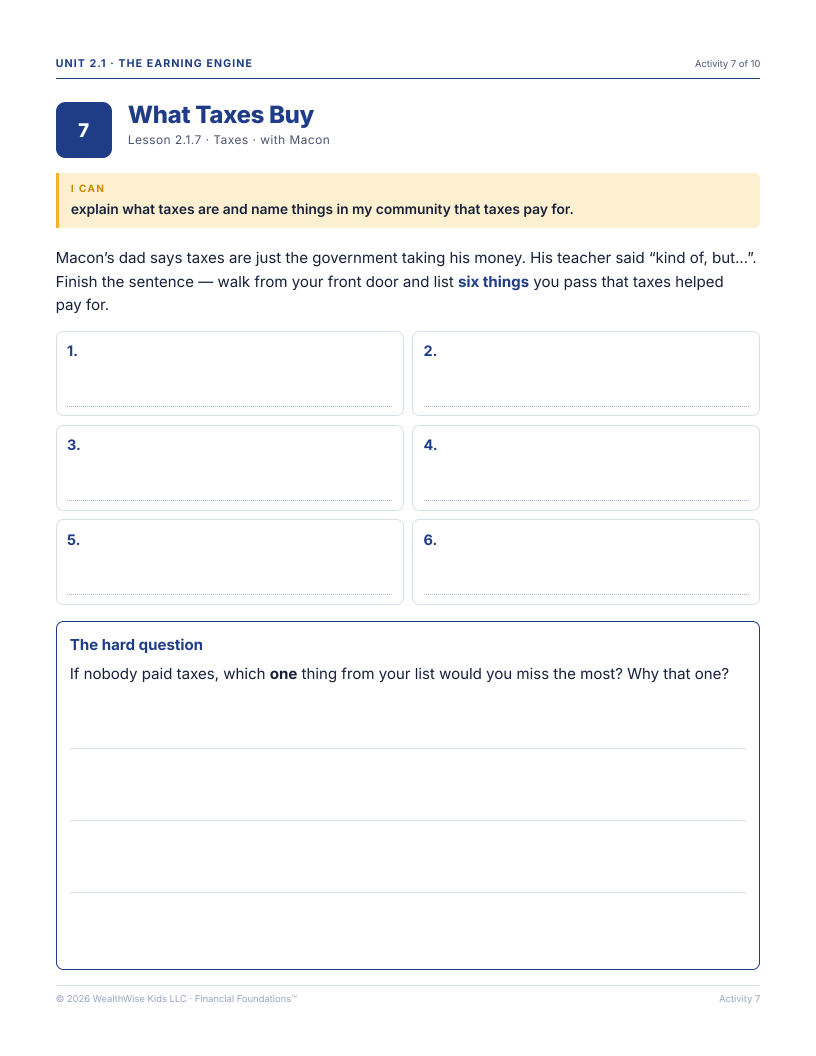
Walk out of your front door and list six things you pass that taxes helped pay for. Then say which one you would miss the most, and why that one.
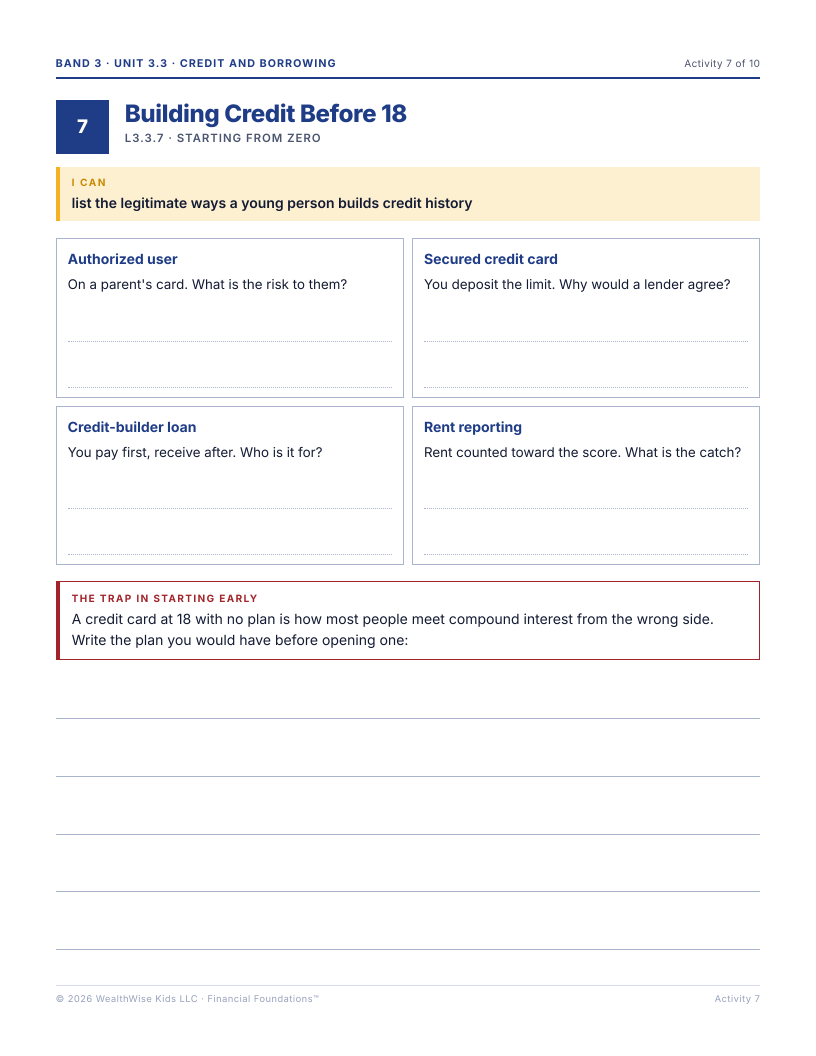
Four legitimate ways a young person starts a credit history, and the catch in each one — including who is carrying the risk.
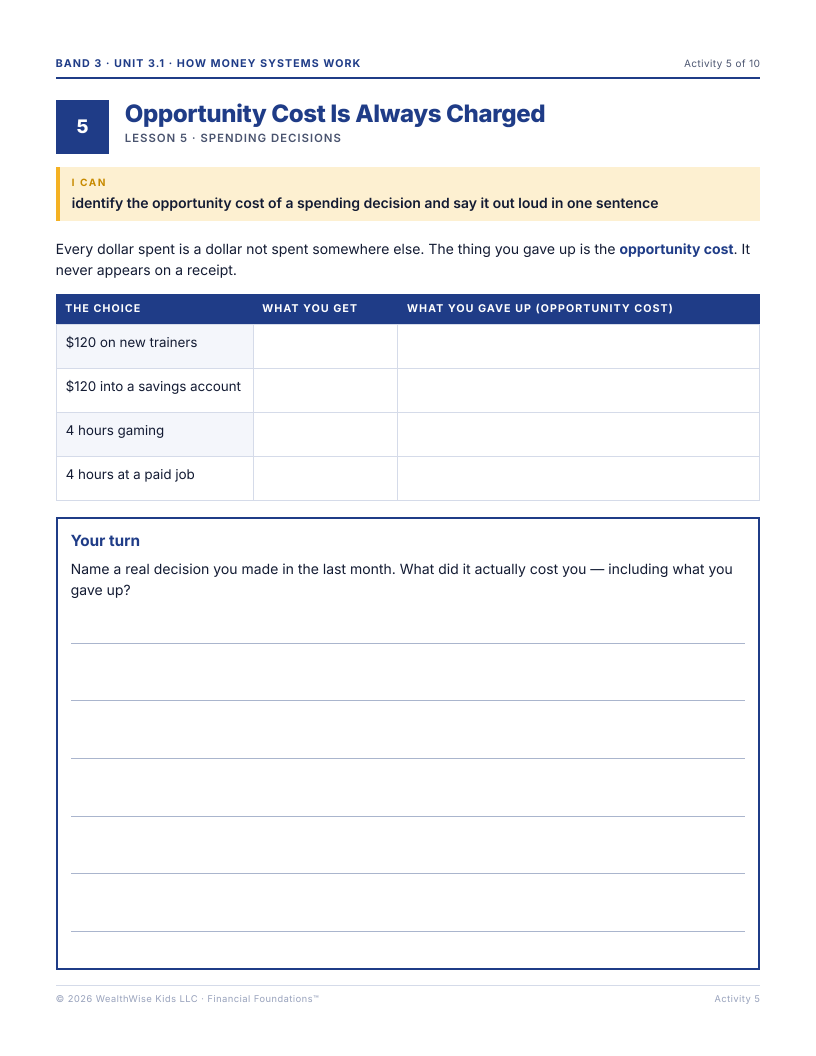
Four choices, each with something gained and something given up — including the sensible ones. Then name a real decision from your own last month.
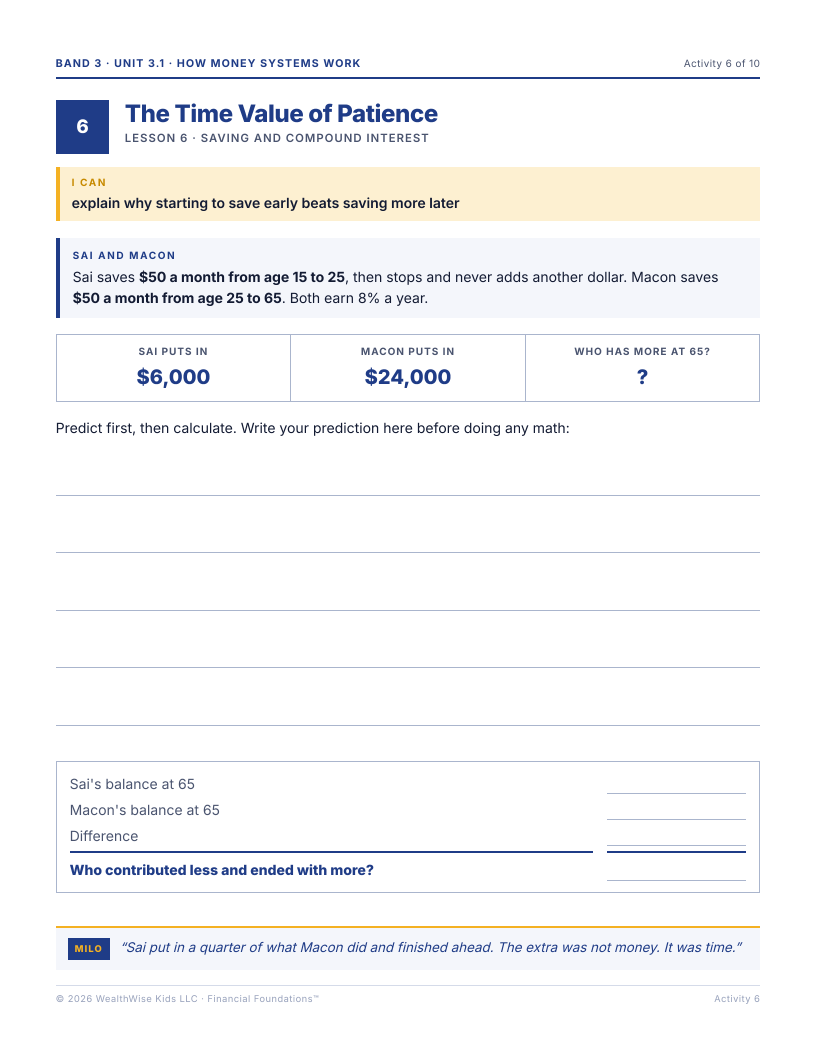
Sai saves $50 a month from 15 to 25 and stops. Macon saves $50 a month from 25 to 65. Predict who has more at 65, then do the math.
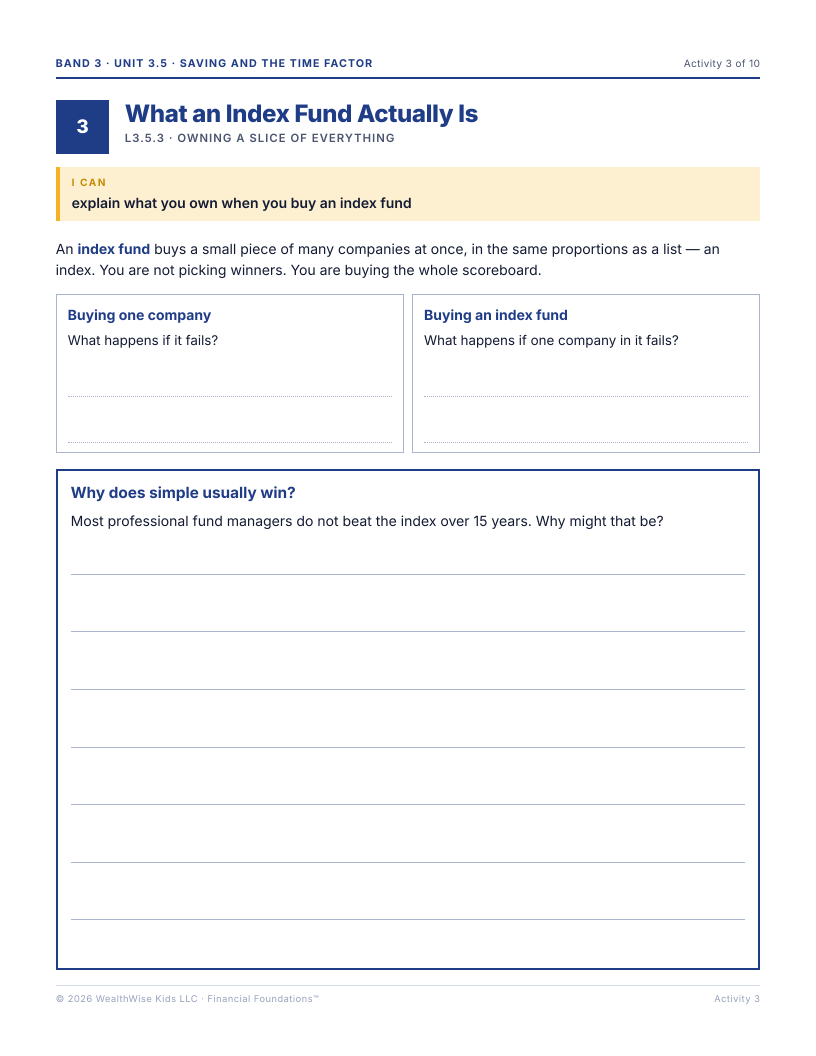
What happens if the one company you bought fails, what happens if one company inside an index fund fails, and why simple usually beats clever.
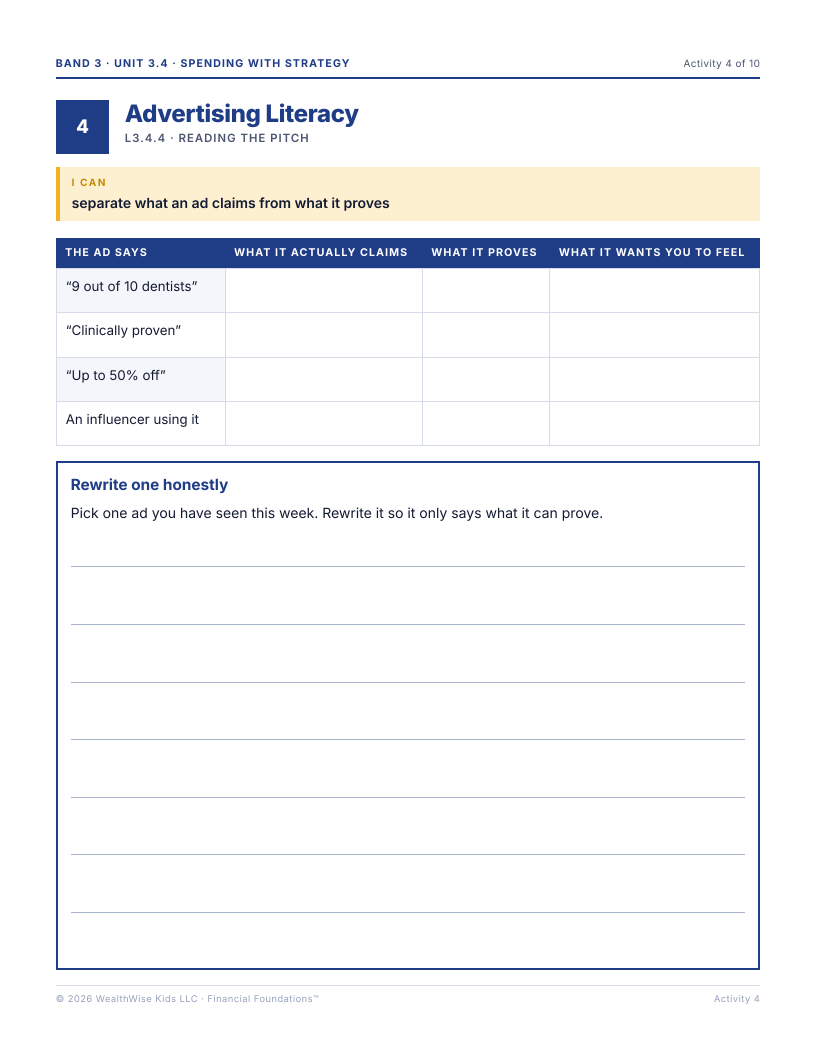
Four real advertising lines. For each one: what it actually claims, what it proves, and what it wants you to feel. Then rewrite one honestly.
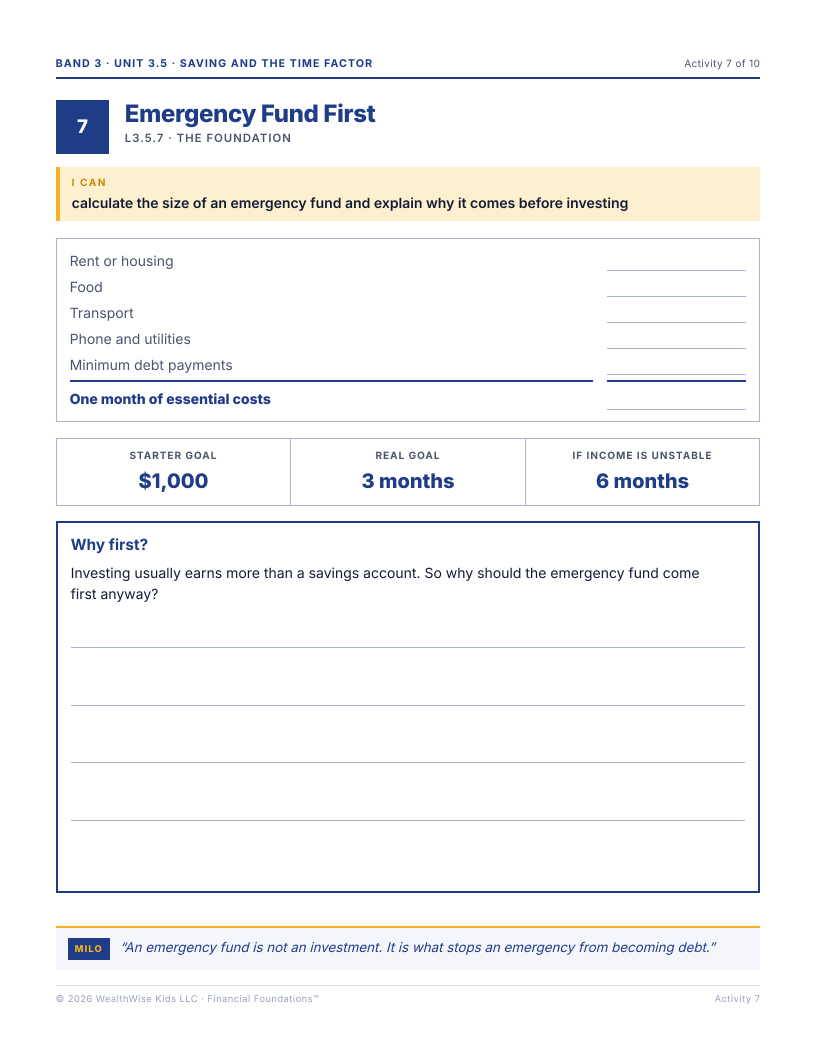
List five essential monthly costs, total them, then size a starter fund, a three-month fund and a six-month fund — and say why this comes before investing.
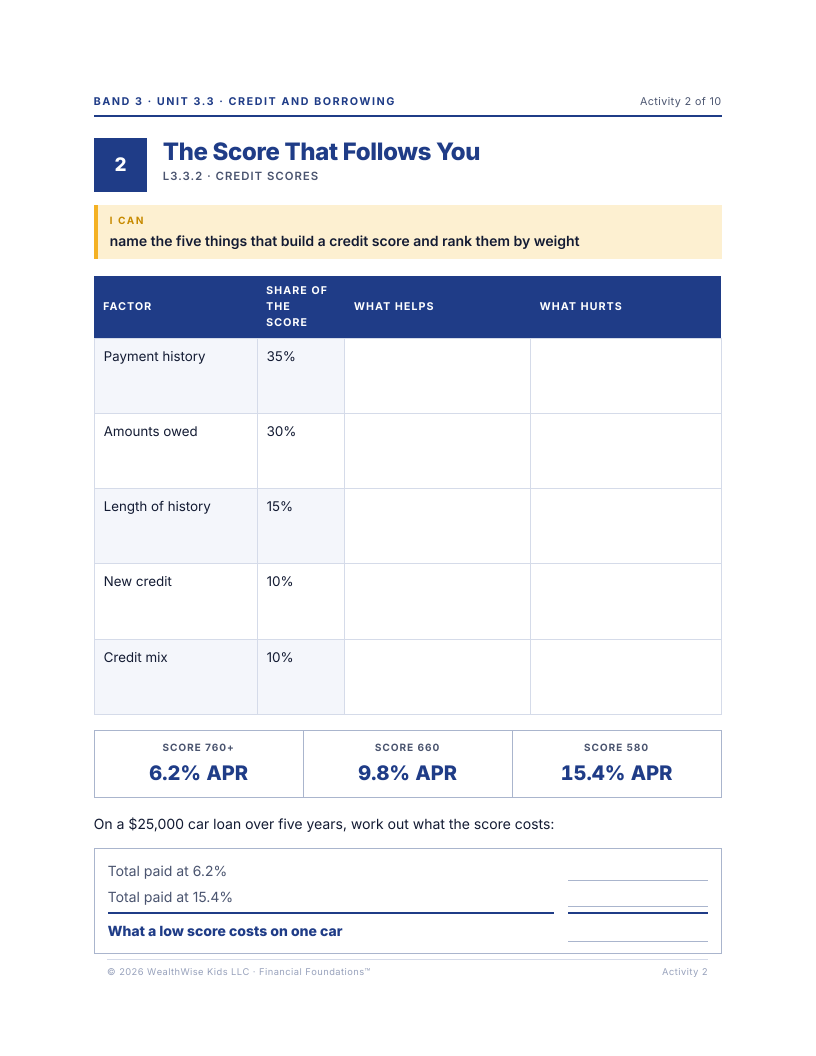
The five things that build a credit score and what each is worth, then the same $25,000 car loan priced at three different scores.
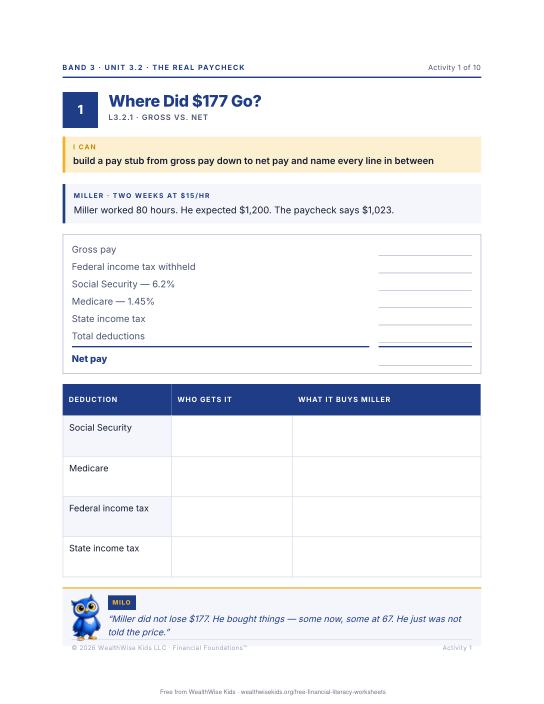
Miller worked 80 hours at $15 and expected $1,200. His paycheck says $1,023. Students build the pay stub from gross to net and name who gets each deduction.
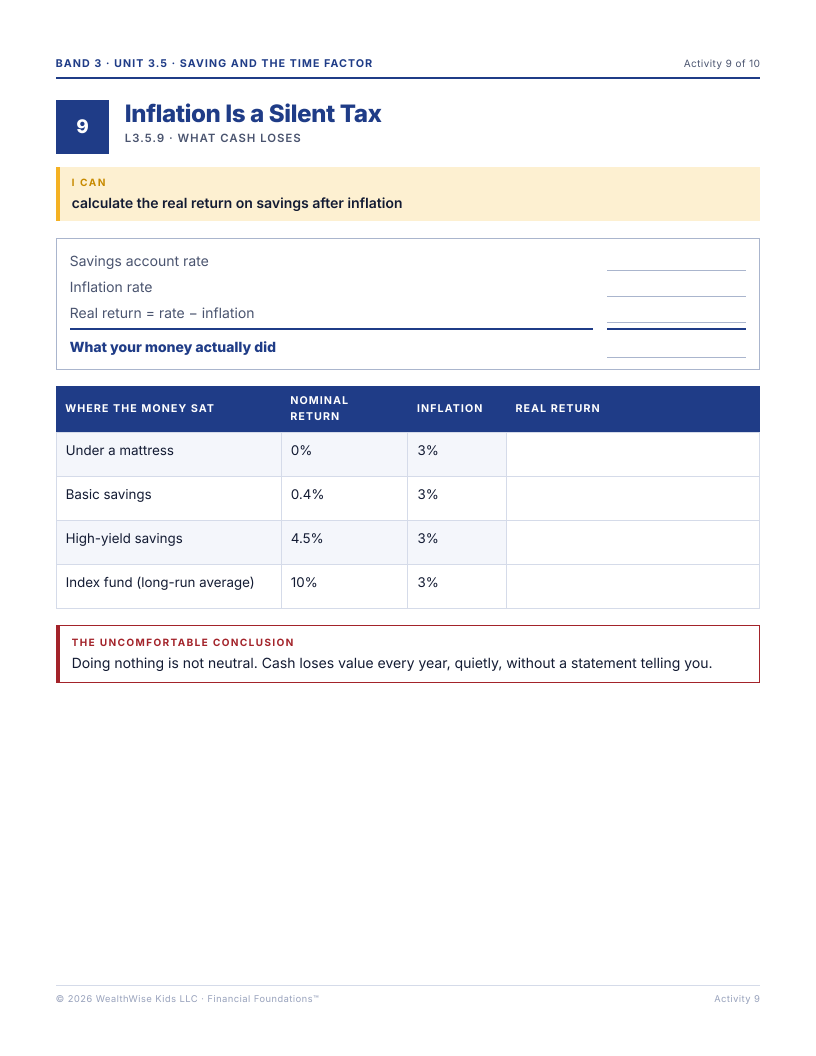
Four places money can sit, each with a nominal rate. Subtract 3% inflation from each and find out which ones actually lost value.
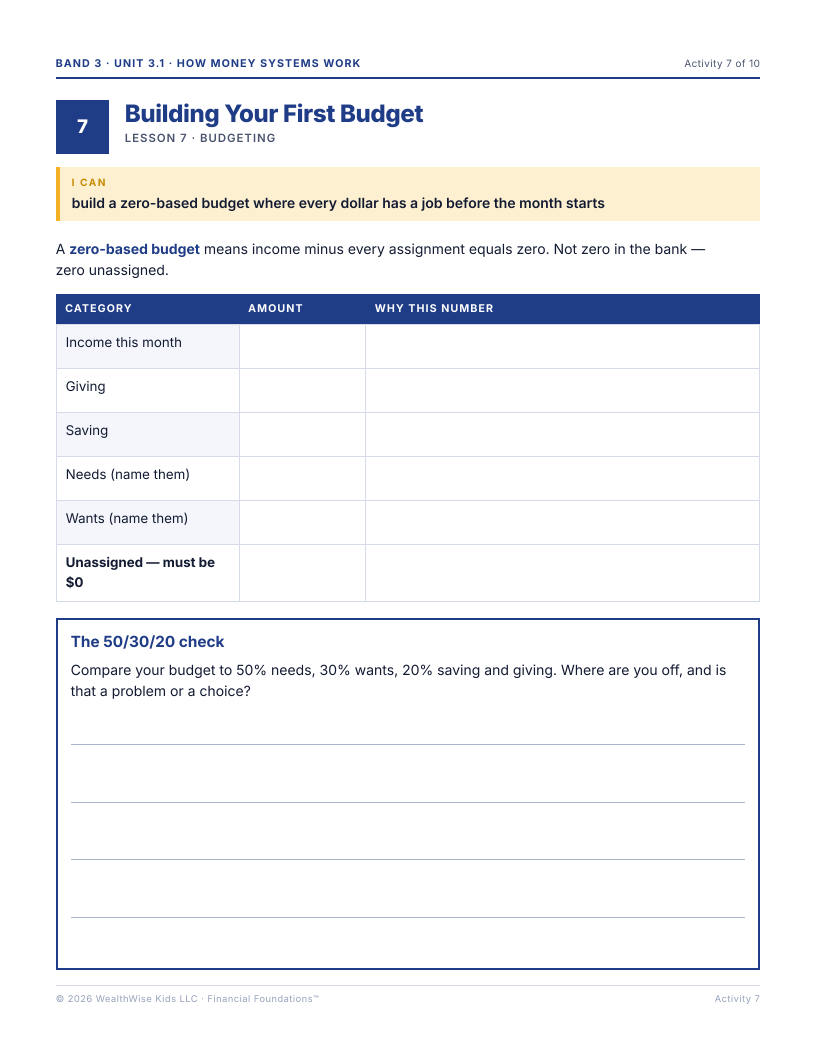
A zero-based budget where every dollar gets a job before the month starts. The last row has to read $0, and there is a column asking why each number is what it is.
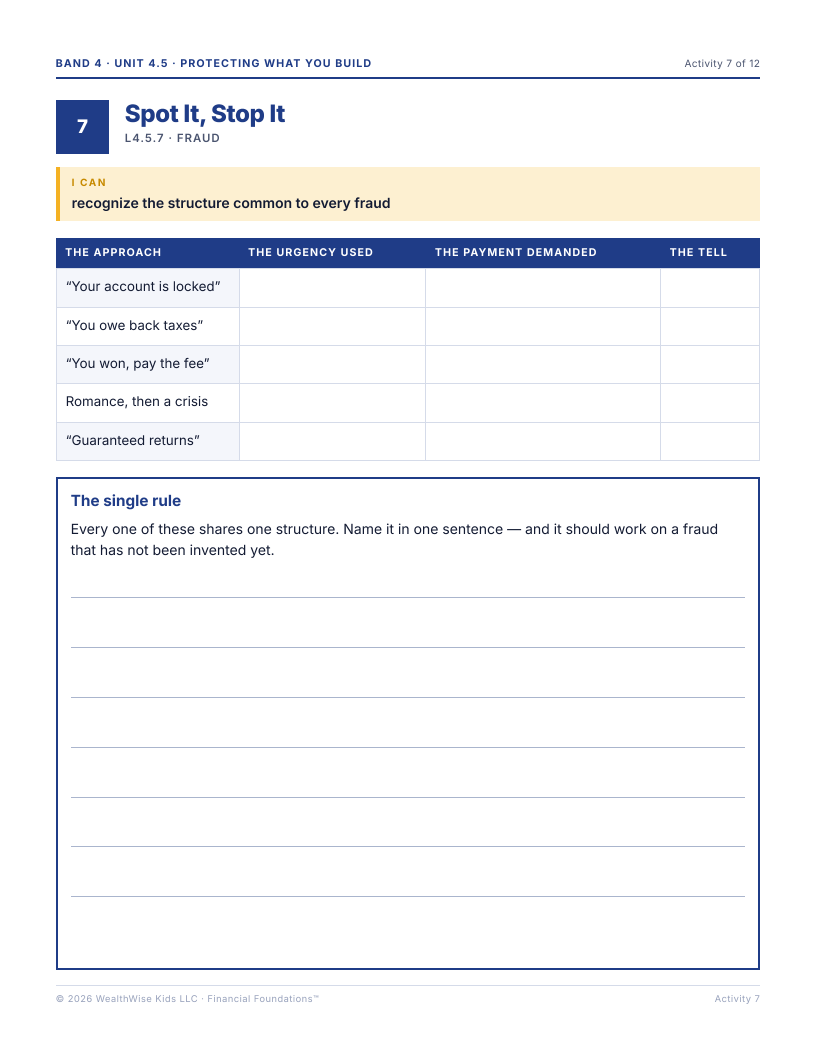
Five common frauds broken into approach, urgency, payment and tell — then name the one structure they all share, in a sentence that works on a scam nobody has invented yet.
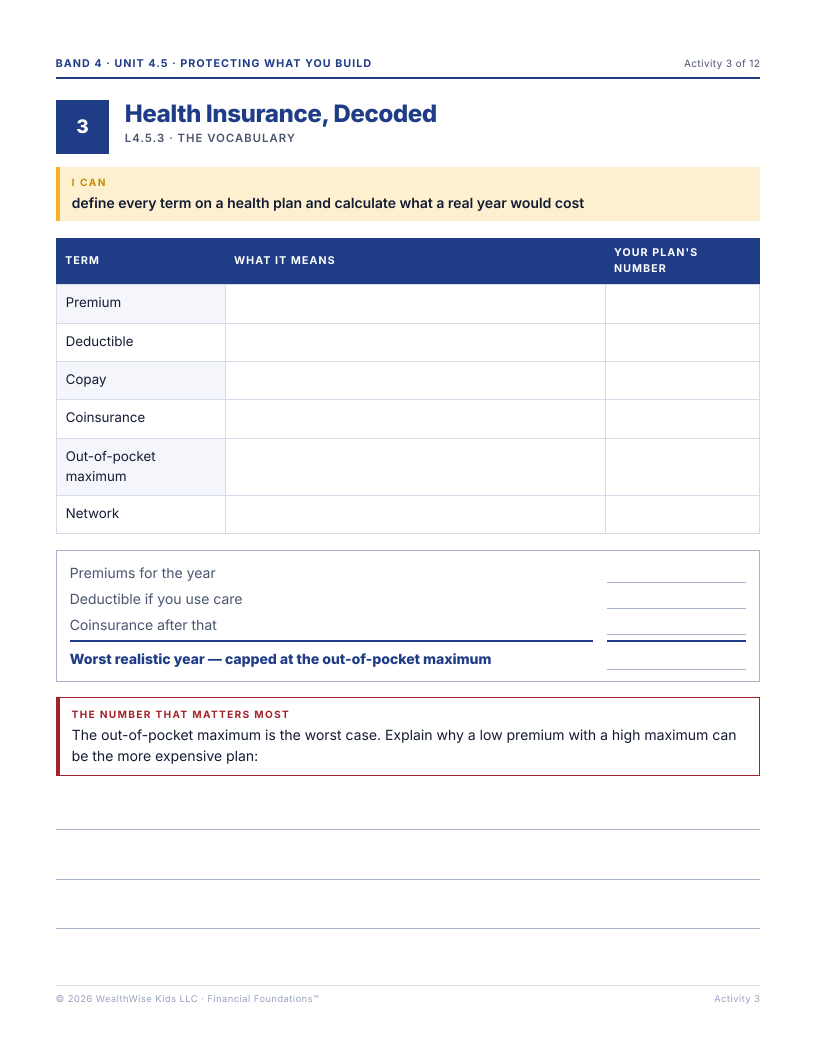
Define the six words on every health plan, then work out what a real year actually costs — including the year nothing happens.
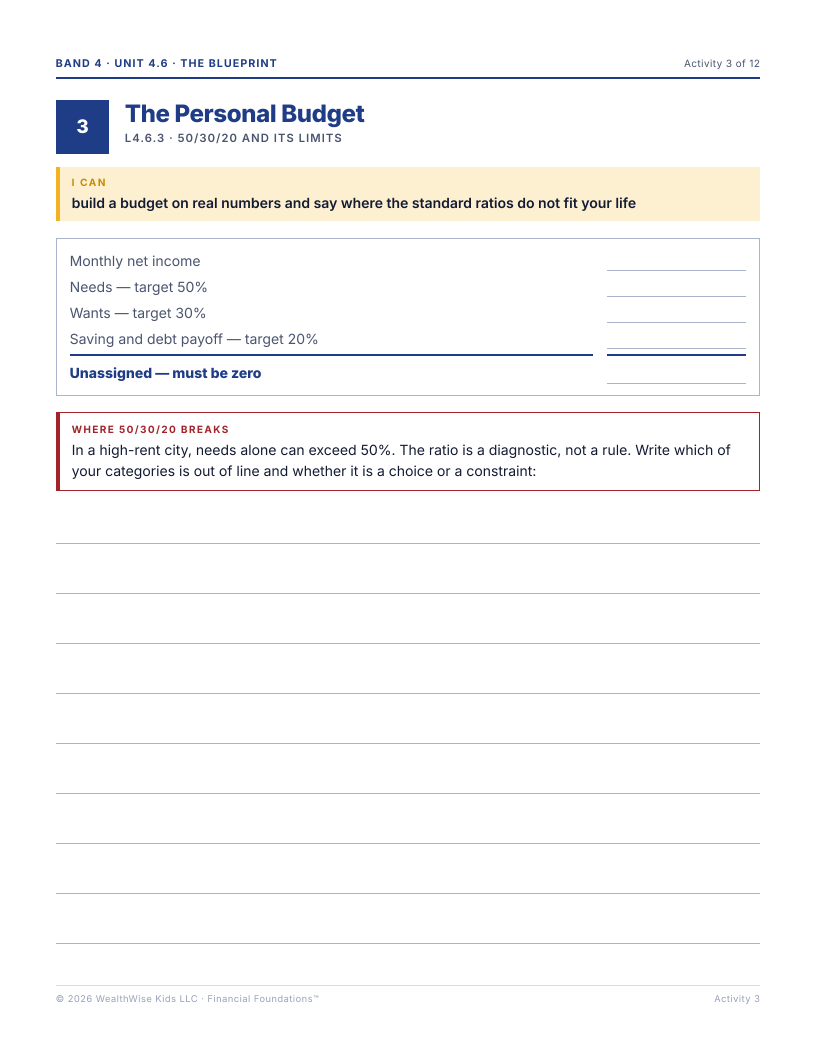
Build a real budget on your own take-home pay against the 50/30/20 targets, get the unassigned line to zero, then say where the rule does not fit your life.
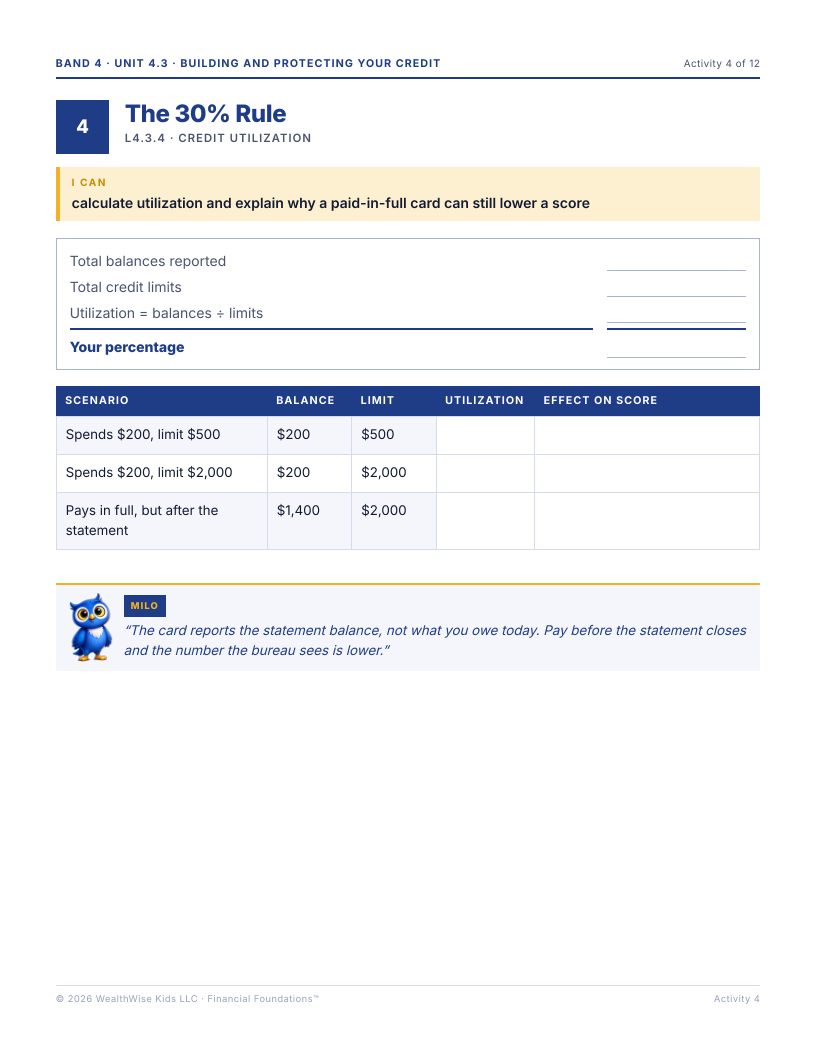
Three cards, the same spending, three different outcomes — including someone who pays in full every month and still reports 70% utilization.
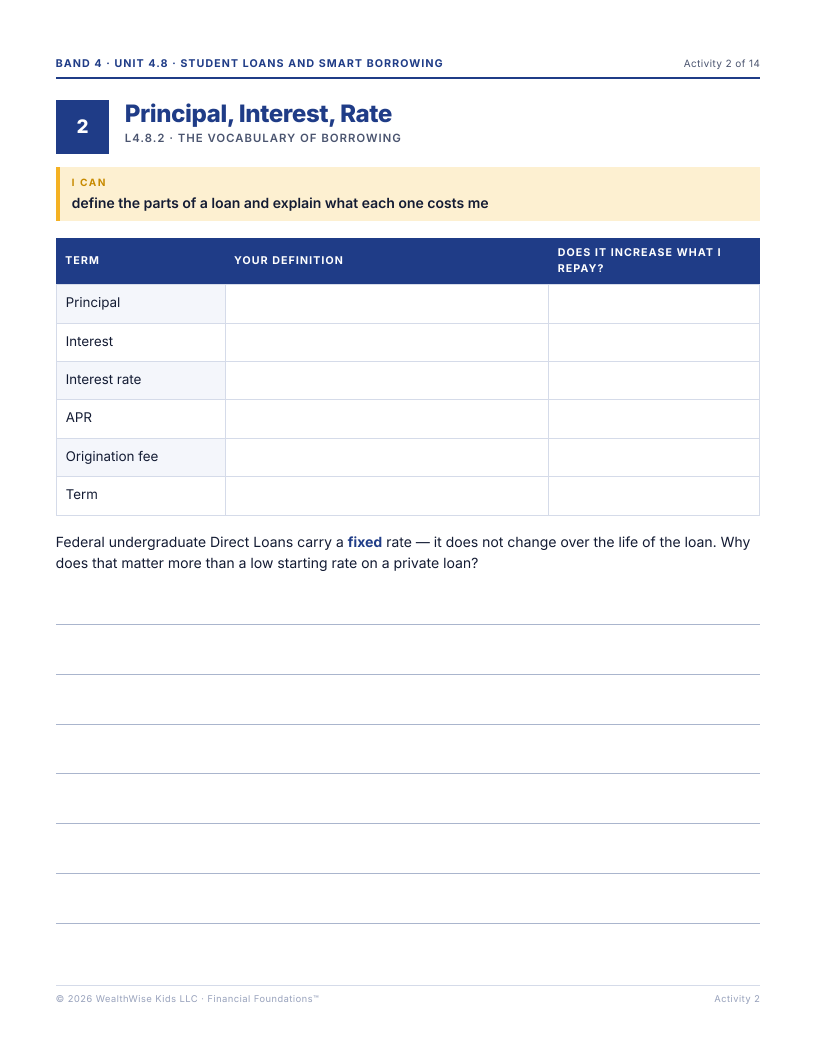
Define the six words on every loan document — principal, interest, interest rate, APR, origination fee, term — and say which of them increase what you repay.
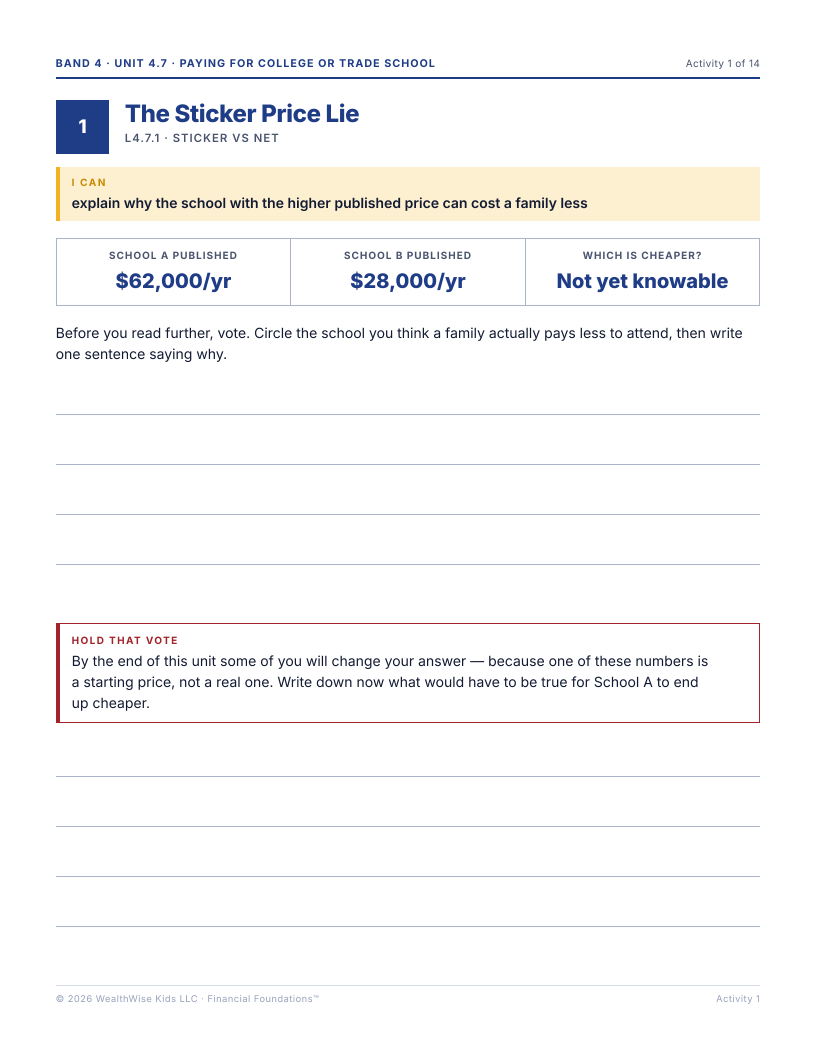
Two schools, $62,000 and $28,000 a year. Vote on which is cheaper, then subtract gift aid and find out that the expensive one costs the family $8,500 a year less.
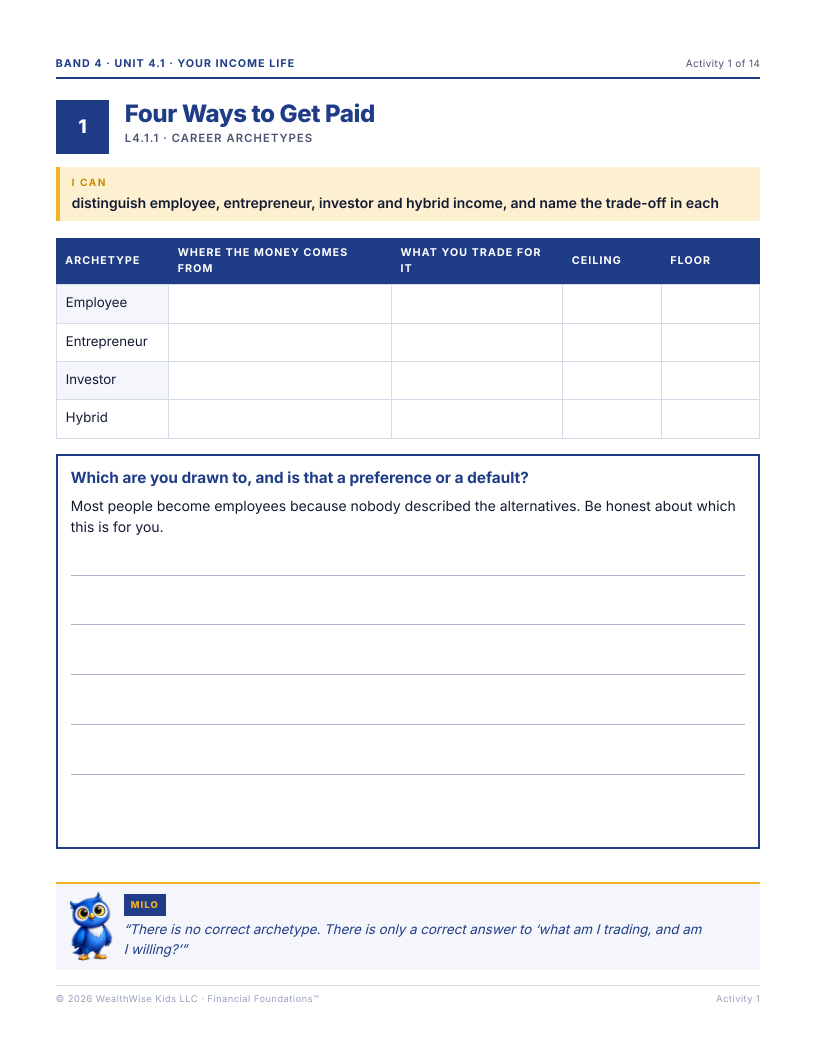
Employee, entrepreneur, investor, hybrid. Where the money comes from in each, what you trade for it, and what the ceiling and the floor really are.
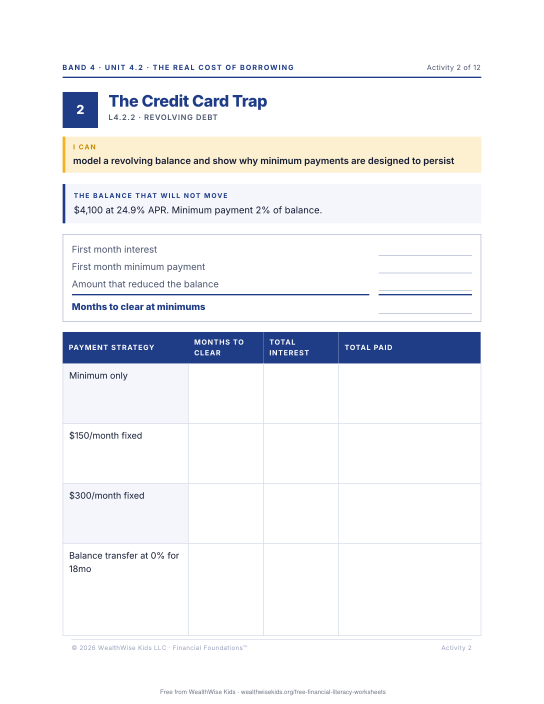
A $4,100 balance at 24.9% APR. Compare paying the minimum, $150 a month, $300 a month and a 0% transfer, and see why the minimum never gets there.
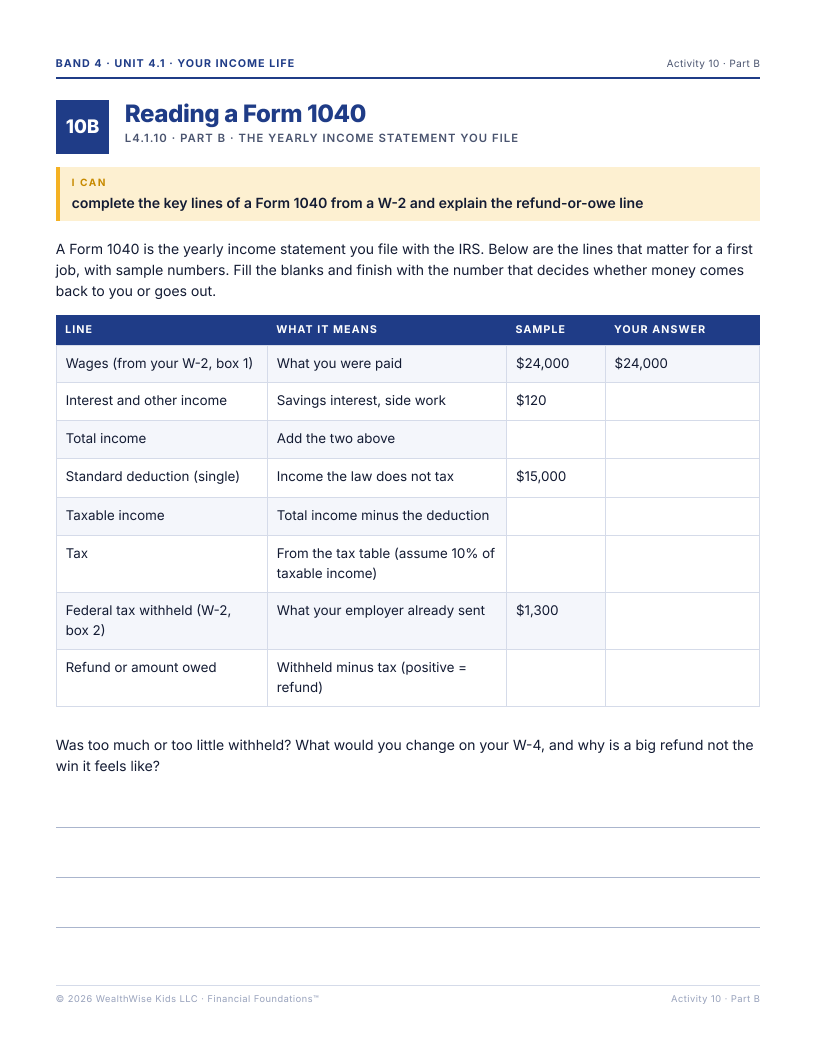
The eight lines of a Form 1040 that matter for a first job, with sample numbers from a W-2. Work down to the line that decides whether money comes back or goes out.
Or browse by topic: Money Basics · Budgeting & Financial Math · Careers & Income · Investing & Wealth · Real-World Scenarios
A free five-day money game in the browser. Students get a starting balance scaled to their age ($20, $50 or $100) and a week of real choices. No account, no login.
Play it free →What a child should understand at each grade band, and four things to do at home for each one without a worksheet.
Read the guide →A compound interest calculator and a savings goal planner, built so a student can change the numbers and see what happens.
Open the calculators →New to teaching kids about money? Start with our guide to financial literacy for kids, and if April is coming, the Financial Literacy Month plan uses these sheets week by week.
Yes. No account, no email, no trial. Download the PDF, print as many copies as you need, and use them in a classroom, a homeschool, an after-school program or at home. We only ask that you share the link rather than reposting the file.
Every download ends with an answer page: what a good answer looks like for each activity, plus one question to ask when the pencils go down.
Need or Want? and Every Coin Has a Value are for kindergarten to second grade, 50/30/20 for third to fifth, Where Did $177 Go? for sixth to eighth, and The Credit Card Trap for high school. Older students often enjoy the younger sheets as a warm-up.
About 20 to 30 minutes, including the conversation. Each one is a single page.
Each is one activity, unchanged, from a unit of Financial Foundations™, the WealthWise Kids K–12 financial literacy curriculum. The full units run 10 to 12 lessons with teacher scripts, family letters and a checkpoint.
Can’t find what you need?
Tell us what you were looking for. These requests decide what we build next, and everything we build this way stays free.
Liked the worksheet?
Teachers can run a free five-week pilot with one class. Families can take the five-week Family Edition home.