
Grades 6–8Ages 11–14 · Unit 3.3 · Credit and Borrowing
The score that follows you: a free credit worksheet for grades 6–8.
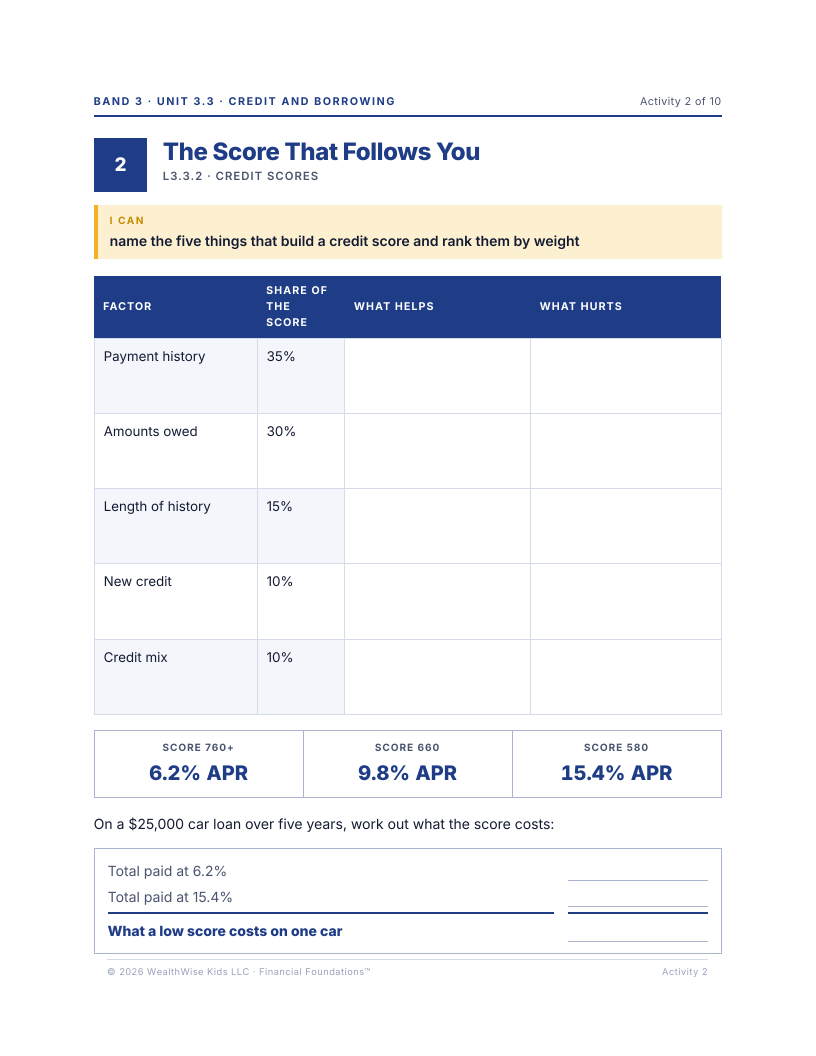
A credit score is five numbers in a trench coat, and most adults could not name three of them. Students fill in what helps and what hurts for each factor, then do the part that lands: the same $25,000 car, over the same five years, priced at three different scores.
No account. No email. Nothing collected about your child.
What is on the page
- The five score factors with their weights to complete
- What helps and what hurts, for each one
- A $25,000 car loan priced at 6.2%, 9.8% and 15.4% APR
- An answer page with the loan worked in full
What it teaches
- What actually builds and damages a credit score
- That payment history and amounts owed are most of it
- Turning an interest rate into a dollar difference
How to run it
Have them guess the gap before they calculate it. Most students say a few hundred dollars. It is closer to $6,900 on one car, and the surprise is what makes the rest of the unit land.
The other free worksheets
Grades K–2
Need or Want?
Six everyday things to sort into needs and wants, then one of each to draw.
Get this one ›Grades K–2
Three Jars, Not Two
Ten coins across three jars — spend, save and give. They must add up to ten.
Get this one ›Grades K–2
Every Coin Has a Value
Write what a penny, nickel, dime and quarter are worth, then draw a dollar bill.
Get this one ›Grades K–2
The Saving Jar
Ten circles. Color one for every coin saved, and watch the month add up.
Get this one ›Grades K–2
Making Choices at the Store
Three coins, eight things. Circle what you would buy.
Get this one ›Grades K–2
Not Enough For Everything
Three coins, four things. Count, decide, and choose which three.
Get this one ›Grades K–2
My Saving Goal
Name what you are saving for, what it costs, and when you want it by.
Get this one ›Grades 3–5
50 / 30 / 20
A first budget: split $10, $20 and $50 across needs, wants and saving.
Get this one ›Grades 3–5
The Impulse Trap
Multiply one unplanned snack out across a year, then test the 24-hour rule.
Get this one ›Grades 3–5
Set a SMART Goal
Turn a vague saving wish into a goal with a number, a date and a weekly amount.
Get this one ›Grades 3–5
Sort the Earner
Eight people, eight ways of getting paid. Name the income type for each.
Get this one ›Grades 3–5
The Four Players
Match five everyday events to households, businesses, banks or government.
Get this one ›Grades 3–5
Fixed or Variable?
Six costs. Fixed or variable — and which could you actually change?
Get this one ›Grades 3–5
What Is a Bank Account?
Five jobs for money. Savings, checking, or cash?
Get this one ›Grades 3–5
Unit Price Math
Four pairs of packages. Work out the price of one, then say which is really cheaper.
Get this one ›Grades 6–8
Building Credit Before 18
Four real ways to start a credit history, and the catch in each.
Get this one ›Grades 6–8
Opportunity Cost Is Always Charged
Four choices. What you get, and what you gave up to get it.
Get this one ›Grades 6–8
The Time Value of Patience
Sai saves for ten years and stops. Macon saves for forty. Who has more at 65?
Get this one ›Grades 6–8
What an Index Fund Actually Is
What you actually own when you buy an index fund — and why simple usually wins.
Get this one ›Grades 6–8
Advertising Literacy
Four ad lines. What each claims, what it proves, and what it wants you to feel.
Get this one ›Grades 6–8
Emergency Fund First
Size an emergency fund from your own costs, and say why it comes before investing.
Get this one ›Grades 6–8
Where Did $177 Go?
Miller earned $1,200 and was paid $1,023. Build the pay stub and find the $177.
Get this one ›Grades 9–12
Spot It, Stop It
Five frauds, one shared structure. Name it in a sentence.
Get this one ›Grades 9–12
Health Insurance, Decoded
The six words on every health plan, and what a real year costs.
Get this one ›Grades 9–12
The Personal Budget
Build a budget on your own numbers, then say where 50/30/20 breaks.
Get this one ›Grades 9–12
The 30% Rule
Three cards, the same spending, three different scores. Work out why.
Get this one ›Grades 9–12
Principal, Interest, Rate
Define the six words on every loan document, and say which raise what you repay.
Get this one ›Grades 9–12
Sticker, Gift, Net
Two schools, two sticker prices. Subtract gift aid and find out which really costs less.
Get this one ›Grades 9–12
Four Ways to Get Paid
Employee, entrepreneur, investor, hybrid — what each one trades, and its ceiling and floor.
Get this one ›Grades 9–12
The Credit Card Trap
A $4,100 balance at 24.9% APR, and four ways to pay it down.
Get this one ›Grades 3–5
What Taxes Buy
List six things taxes paid for on your street — then rank them.
Get this one ›Grades 6–8
Inflation Is a Silent Tax
Four places to keep money. After 3% inflation, which ones lost?
Get this one ›Grades 6–8
Building Your First Budget
Give every dollar a job. The last row has to come out at $0.
Get this one ›Grades 9–12
Reading a Form 1040
Eight 1040 lines from a first-job W-2. Refund, or do you owe?
Get this one ›See all 35 free financial literacy worksheets, read what seventh grade learns about money, or start with our guide to financial literacy for kids.
Where it comes from
Unit 3.3 · Credit and Borrowing of a 266-lesson curriculum.
This sheet is one activity, unchanged, from Financial Foundations™. Teachers can run a free five-week pilot with one class. Families can take the Family Edition home.