
Grades 3–5Ages 8–11 · Unit 2.2 · Smart Spending
Unit price math: a free comparison worksheet for grades 3–5.
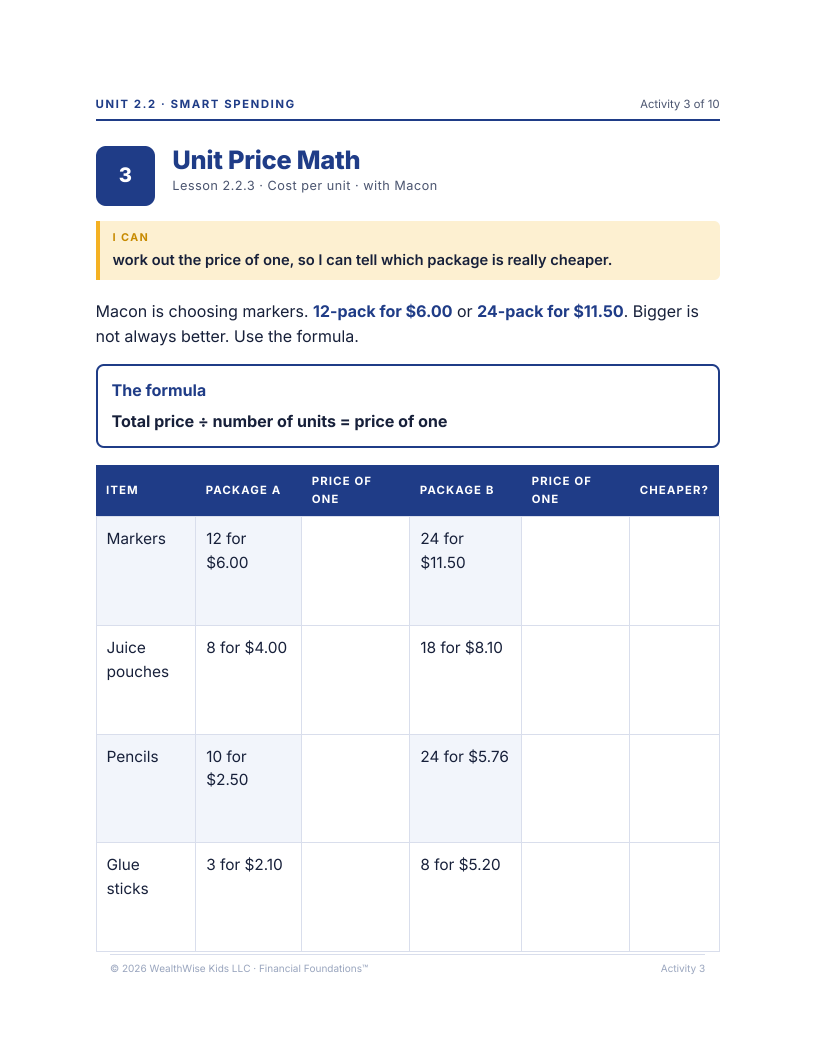
Every supermarket aisle asks a child the same question and almost never gets a real answer: is the big one actually cheaper? This sheet gives four pairs of packages and one formula — total price divided by number of units — and lets them find out.
No account. No email. Nothing collected about your child.
What is on the page
- Four pairs of packages to compare
- The formula, stated once at the top
- A column to mark which package is really cheaper
- An answer page, with a fifth pair to try out loud
What it teaches
- Dividing to find a price per unit
- Comparing two options on the same measure
- That the bigger package is usually, but not always, the better buy
How to run it
In this set the larger pack wins every time, so a quick student can get all four right without dividing once. Say that out loud, then give them a pair where it flips: 6 erasers for $1.80 against 10 for $3.20.
The other free worksheets
Grades K–2
Need or Want?
Six everyday things to sort into needs and wants, then one of each to draw.
Get this one ›Grades K–2
Every Coin Has a Value
Write what a penny, nickel, dime and quarter are worth, then draw a dollar bill.
Get this one ›Grades K–2
My Saving Goal
Name what you are saving for, what it costs, and when you want it by.
Get this one ›Grades 3–5
50 / 30 / 20
A first budget: split $10, $20 and $50 across needs, wants and saving.
Get this one ›Grades 6–8
The Score That Follows You
The five things that build a credit score — and what a low one costs on one car loan.
Get this one ›Grades 6–8
Where Did $177 Go?
Miller earned $1,200 and was paid $1,023. Build the pay stub and find the $177.
Get this one ›Grades 9–12
The Credit Card Trap
A $4,100 balance at 24.9% APR, and four ways to pay it down.
Get this one ›See all four free financial literacy worksheets, read what fourth grade learns about money, or start with our guide to financial literacy for kids.
Where it comes from
Unit 2.2 · Smart Spending of a 266-lesson curriculum.
This sheet is one activity, unchanged, from Financial Foundations™. Teachers can run a free five-week pilot with one class. Families can take the Family Edition home.