
Grades 9–12Ages 14–18 · Unit 4.6 · The Blueprint
The personal budget: a free worksheet for high school.
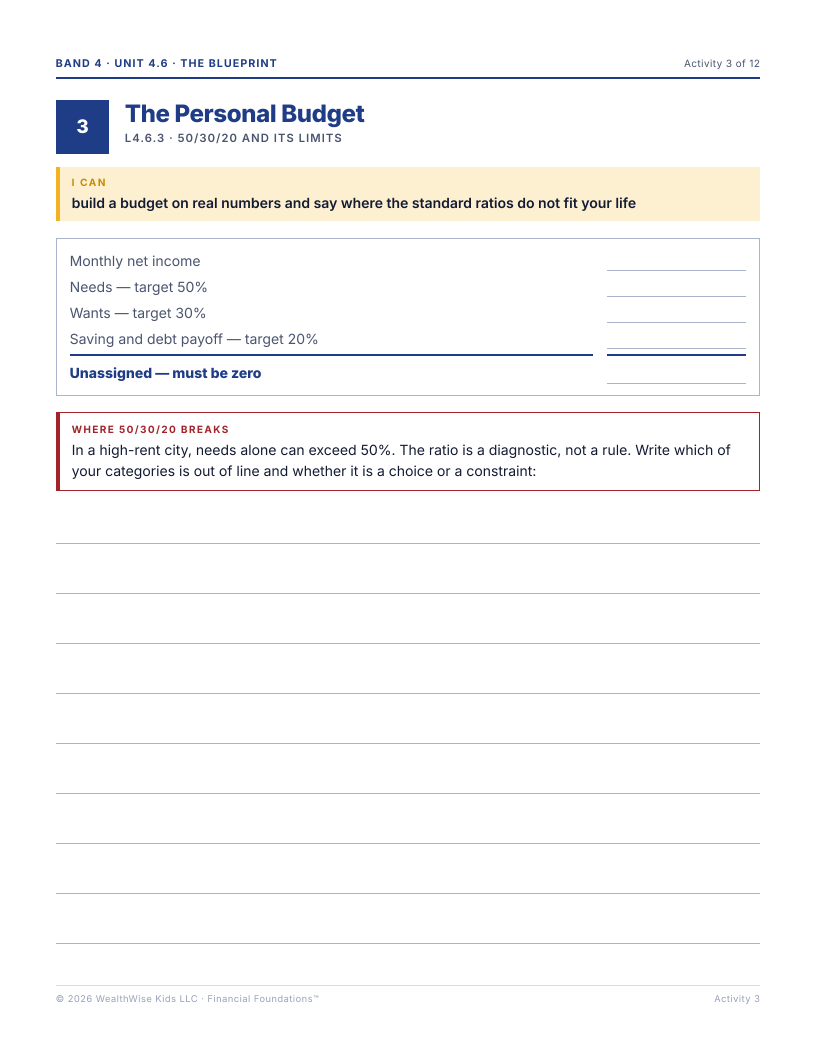
Most budget worksheets hand a student fictional numbers and a tidy rule. This one asks for their own take-home pay, makes every dollar carry a job until the unassigned line reads zero, and then asks the question the tidy version never does: where does 50/30/20 not fit your life, and is that a choice or a constraint?
No account. No email. Nothing collected about your child.
What is on the page
- Four lines to complete against monthly net income
- An unassigned line that has to reach zero
- A written section on where the ratio breaks
- An answer page covering both halves
What it teaches
- Giving every dollar a job before the month starts
- Treating saving as a category, not a leftover
- Judging when a standard rule does not apply to you
How to run it
Ask which line they filled in last. Nearly every student writes saving last and gives it whatever survives — this sheet is built to make that visible.
The other free worksheets
Grades K–2
Need or Want?
Six everyday things to sort into needs and wants, then one of each to draw.
Get this one ›Grades K–2
Three Jars, Not Two
Ten coins across three jars — spend, save and give. They must add up to ten.
Get this one ›Grades K–2
Every Coin Has a Value
Write what a penny, nickel, dime and quarter are worth, then draw a dollar bill.
Get this one ›Grades K–2
My Saving Goal
Name what you are saving for, what it costs, and when you want it by.
Get this one ›Grades 3–5
50 / 30 / 20
A first budget: split $10, $20 and $50 across needs, wants and saving.
Get this one ›Grades 3–5
Set a SMART Goal
Turn a vague saving wish into a goal with a number, a date and a weekly amount.
Get this one ›Grades 3–5
Sort the Earner
Eight people, eight ways of getting paid. Name the income type for each.
Get this one ›Grades 3–5
The Four Players
Match five everyday events to households, businesses, banks or government.
Get this one ›Grades 3–5
Unit Price Math
Four pairs of packages. Work out the price of one, then say which is really cheaper.
Get this one ›Grades 6–8
The Time Value of Patience
Sai saves for ten years and stops. Macon saves for forty. Who has more at 65?
Get this one ›Grades 6–8
Advertising Literacy
Four ad lines. What each claims, what it proves, and what it wants you to feel.
Get this one ›Grades 6–8
Emergency Fund First
Size an emergency fund from your own costs, and say why it comes before investing.
Get this one ›Grades 6–8
The Score That Follows You
The five things that build a credit score — and what a low one costs on one car loan.
Get this one ›Grades 6–8
Where Did $177 Go?
Miller earned $1,200 and was paid $1,023. Build the pay stub and find the $177.
Get this one ›Grades 9–12
Principal, Interest, Rate
Define the six words on every loan document, and say which raise what you repay.
Get this one ›Grades 9–12
Sticker, Gift, Net
Two schools, two sticker prices. Subtract gift aid and find out which really costs less.
Get this one ›Grades 9–12
Four Ways to Get Paid
Employee, entrepreneur, investor, hybrid — what each one trades, and its ceiling and floor.
Get this one ›Grades 9–12
The Credit Card Trap
A $4,100 balance at 24.9% APR, and four ways to pay it down.
Get this one ›See all four free financial literacy worksheets, read what twelfth grade learns about money, or start with our guide to financial literacy for kids.
Where it comes from
Unit 4.6 · The Blueprint of a 266-lesson curriculum.
This sheet is one activity, unchanged, from Financial Foundations™. Teachers can run a free five-week pilot with one class. Families can take the Family Edition home.