
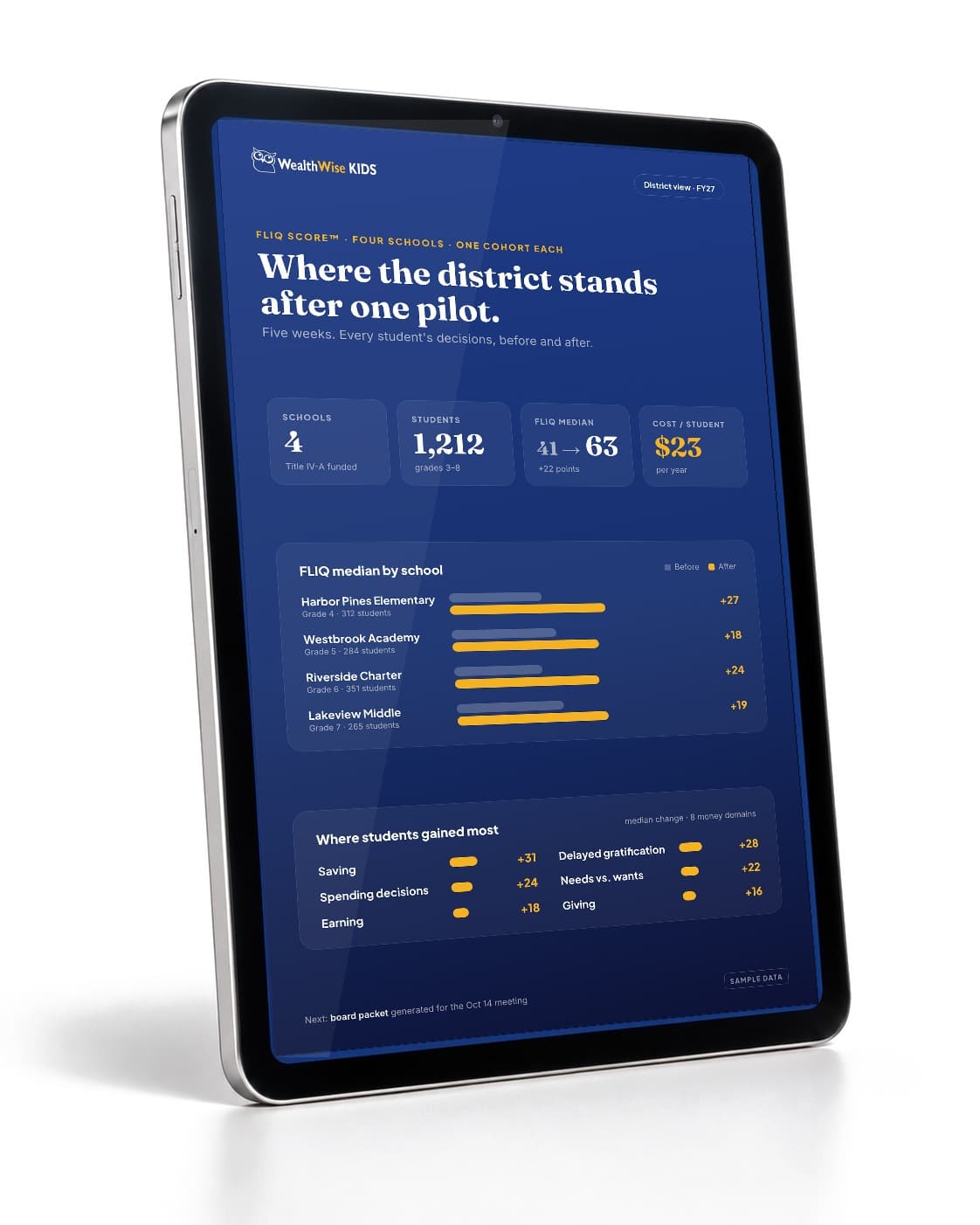
What it costs, in fifteen seconds.
Licensed per school, per year. Start with one classroom or one grade band; grow to a school, then a district. Every tier includes the FLIQ Score™ — it is never removed.
| Tier | Price | Per student | What's included |
|---|---|---|---|
| One teacher | $600 per teacher · year | One teacher's classes, one grade band. | K–2, 3–5, 6–8 or 9–12, for every class that teacher runs, for one year. The way a single teacher begins.Buy a teacher license — $600 → |
| One grade band | From$1,700 per school · band · year | K–2 $1,700 · 3–5 $1,900 · 6–8 $2,250 · 9–12 $2,775 | Every teacher in the school who teaches that band. Families and co-ops buy here too — no procurement. |
| Foundations Where a school starts | $6,900 per school · year | ≈ $20–$28 per student at 250–350 enrolled. | All four bands, the FLIQ Score™, the facilitator dashboard, the free $100 Week™, standards alignment. |
| Plus | From$15,900 per school · year | ≈ $45–$64 per student at 250–350 enrolled. | Foundations + available now: CoinQuest™ (invite-only), facilitator certification. Coming 2026–27: more PlayLab™ games and the classroom portal, Adventures™ classroom read-alouds, iPARENTS™. |
| Complete | From$21,900 per school · year | ≈ $63–$88 per student at 250–350 enrolled. | Plus + available now: Real-World Pathways™ built into your classes (the visits stay free for every school). Coming 2026–27: the Real-World Capstone™, district dashboard, longitudinal FLIQ. |
| Nonprofits | 15% off any license above | e.g. $600 → $510 · $6,900 → $5,865 | For nonprofit youth programs, libraries, clubs and after-school providers. Free to the program when a bank or funder sponsors it. |
| Districts & networks | Save up to25% volume pricing | 2+ schools 10% · 5+ schools 15% · district-wide 25%. | The more students you serve, the more efficient the investment becomes. |
Start with a free five-week pilot → Plan your dates
$6,900 per year
For your business office
- Payment
- Purchase order & invoice, standard net terms. Credit or debit card accepted.
- Remit to
- WealthWise Kids LLC, 3343 Peachtree Rd NE, Suite 2235, Atlanta, GA 30326
- EIN
- 41-4716803 · W-9 and formal quote on request
- Documents
- Price sheet (PDF) · Student data summary (PDF)
Who pays it
Lit for: a schoolPublic & charter schools
FitsTitle IV-A
The primary path
Financial literacy is a named allowable use. One invoice code every district already receives.
High-poverty schools
FitsTitle I & CRA
Often $0 to the school
Title I may fund it where it fits the school's plan; a bank or credit union can sponsor it as community development.
Nonprofits & community
Grants & foundations
Funder-ready
Funders want to see what changed. The FLIQ Score™, an emerging measure still being validated, gives them a start-and-end reading.
Private & homeschool
ESAs & Coverdell
$2,000–$8,500 per child
Curriculum and educational technology are named eligible expenses in 18+ states.


Districts commonly fund financial literacy under Title IV-A; your federal-programs office confirms fit. Private schools reach Title I and II-A dollars through their district's equitable-services set-aside. Every source, all twelve ↓
Starting rates, not a contract. Final institutional pricing varies by enrollment, school count, and scope; a formal quote and W-9 are available on request for your PO. District-wide figures estimate 12 schools. Prices valid through 30 June 2027.
Questions about pricing? Book a call →
Every way in has a way to pay.
Most schools can pay with funds they already receive. Title IV-A is our primary path — but it’s far from the only one. Find the row that sounds like you — the funding path and the entry point are already mapped.
Public & Charter Schools
Districts, charter networks, and individual public schools.
Pays for itTitle IV-A, Title I, Title II-A (for training), 21st CCLC, Perkins V (CTE) and REAP (rural) are the paths districts most often use for programmes of this type, so a district can often pay without new local dollars
Way inFive-week pilot → district license (enrollment-based).
Start a pilot →Private & Montessori Schools
Independent, faith-based, and Montessori schools.
Pays for itFederal dollars still reach you through ESEA equitable services (your district's set-aside), plus Coverdell and state ESAs
Way inFive-week pilot, then per-school licensing from $6,900/yr.
Talk to our team →
Homeschool & Families
Homeschool co-ops and individual families.
Pays for itIn education-savings-account states (Arizona, Florida + 16 more), $7,000–$8,500 per child covers curriculum and technology
Way inStart free with The $100 Week™, then the five-week Family Edition — $49 for one household, one time. No procurement, no account.
See the family path →After-School, Community & Nonprofits
Boys & Girls Clubs, urban leagues, libraries, faith and youth programs.
Pays for it21st Century Community Learning Centers (Title IV-B) fund financial literacy directly
Way inPilot, then partner pricing scoped to your program.
Partner with us →Businesses & Funders
Employers, foundations, and financial institutions.
Pays for itSponsor a Title I or low-to-moderate-income school
Way inFund access for a community you care about — we handle delivery.
Sponsor a classroom →* Private-school access to Title I / II is delivered through your local public district’s equitable-services set-aside. Eligibility for any source depends on your entity’s approved plan — we’ll help your team confirm the fit and the right invoice or grant line.
What adoption actually looks like.
Six steps, in this order, every time. Predictable is the point.
- STEP 1Choose your starting pointA free pilot, one grade band, one school, or a district.
- STEP 2A 20-minute onboarding callWe set up your organization in the portal and invite your facilitators. We handle the technology.
- STEP 3Teachers open ready-to-use materialsScripted lessons, facilitator guides, and answer keys — in the portal, nothing to prepare.
- STEP 4Students beginThe $100 Week™, then the five weekly Financial Foundations™ sessions.
- STEP 5FLIQ captures the signalFrom the decisions students make inside the activities — before and after. No extra test.
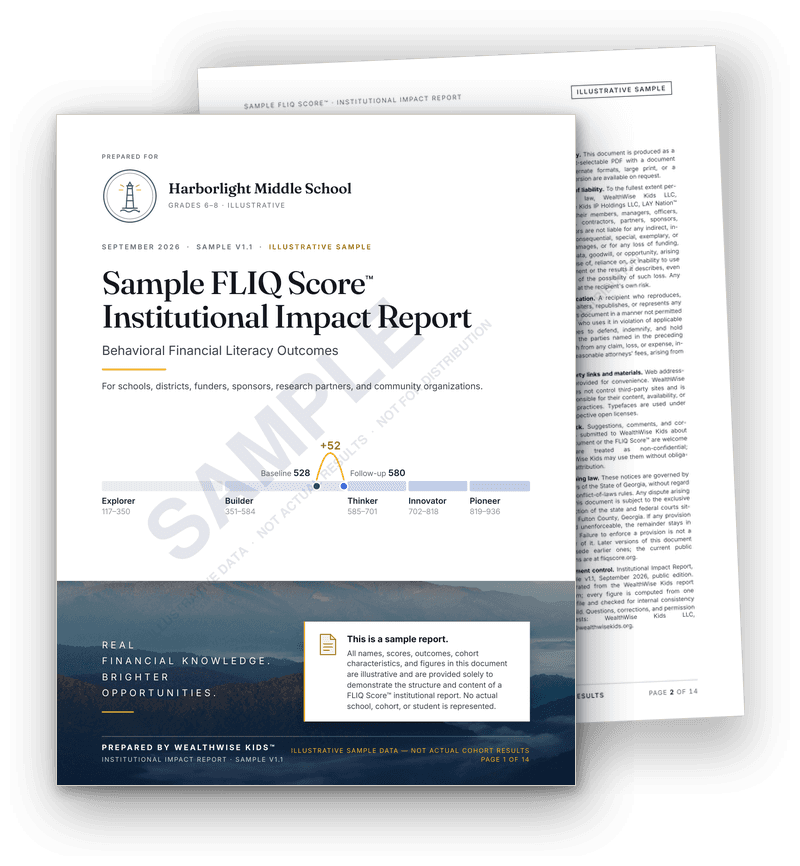
- STEP 6Leaders receive the reportA board-ready FLIQ Score™ report for the cohort, and a decision on what comes next.

Runs in any modern browser — Chromebooks, iPads, laptops, and phones. Nothing to install. Students need no accounts for the pilot.
Safe by design
What we collect, and what we never do →FERPA & COPPA
Built for school use; no direct collection from children
No student accounts
The pilot needs none; The $100 Week™ runs without a login
No bank data
No account numbers, no SSNs, nothing financial about a family
No ads
Nothing is sold to a child, ever
No public ranking
A child never sees a leaderboard or a score used to compare them
Never sold
Never sold. Researchers see only de-identified data, under a written data agreement
FAQ
Do we have to pay to try it?
How does Title IV-A funding work?
Does every student start with $100 in The $100 Week?
Can a family just buy it?
How does pricing compare to other budgets?
Will it be outdated in a few years?
Start free. Fund it your way.
Send a message. You get a written pilot plan and the funding path scoped to your setting — school, home, or community.
Request a Pilot →