
School districts
A K–12 money curriculum that also reads how students decide.
Financial Foundations™ is 266 scripted lessons across four grade bands, K–2 through 9–12. Alongside it, the FLIQ Score™, an emerging measure, reads how students make money decisions, so a district sees more than attendance.
For superintendents, curriculum directors, and the business office.

1 · What a district gets
One license, the whole program.
The K–12 site license includes all six. Nothing here is an add-on with its own invoice.
Curriculum by grade band
Financial Foundations™: 266 lessons across K–2, 3–5, 6–8 and 9–12, sequenced so each band builds on the one before.
The curriculum →Scripted, teacher-ready lessons
Every lesson is scripted, with answer keys and materials. No finance background needed to teach it.
The $100 Week™ simulation
A five-day browser simulation of real spending and saving decisions. It runs without a student login.
Class-level FLIQ Score™ reports
An emerging measure of how students make money decisions, reported for the class and grade band, never ranking a child.
Facilitator dashboard
The teacher's view of the class: who has taken part, and the class report when it is ready.
Standards crosswalk
79 of 95 national standards addressed, self-assessed, unit by unit, with the 16 not yet reached listed.
See the crosswalk →2 · What it costs
Published prices. Nothing to negotiate.
Annual licenses, priced the same for every district. Start with one teacher, one grade band, or the whole school.
Classroom license
$600
per teacher · year
One teacher’s classes in one grade band.
Grade-band school license
$1,700
From · per school · band · year
Every classroom in one grade band at one school.
K–12 site license
Where a school starts
$6,900
per school · year
All four bands for the whole school. About $20–$28 per student at 250–350 students.
Volume and nonprofit pricing
10% off
2+ schools
15% off
5+ schools
25% off
District-wide
15% off
Nonprofit organizations
3 · Start with a free pilot
Try it before anyone signs anything.
One cohort, five weeks, any grade band K–12 — no cost, no contract, no card.
What the district receives at the end
- A cohort report showing how students’ decisions shifted across the five weeks
- Where the cohort places on the FLIQ Score™ bands, for the class as a whole
Five weeks is not yet a growth measure. The pilot shows the program running in your classrooms and how the report reads; it does not claim an outcome.
Read a sample report →fictional school, sample data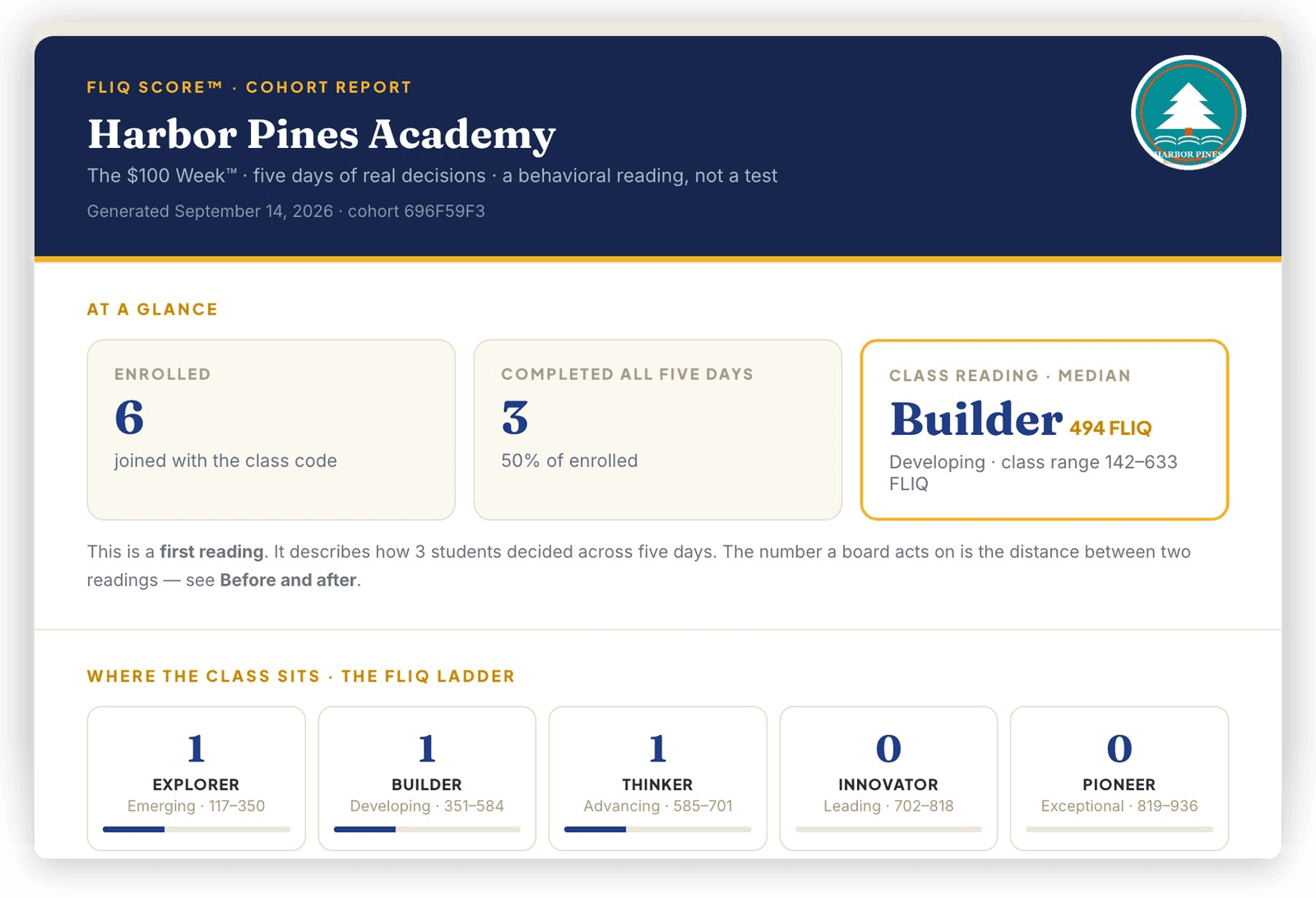
A cohort report page · fictional school, sample data
4 · For the business office
Paperwork your business office will ask for.
The six documents a district usually needs before a purchase order. They are kept together in one place, so nobody has to chase them by email.
W-9
The current IRS form, signed, for your vendor file.
On request
Official price sheet
The published rates and volume discounts on one page, for the PO file.
Download · PDF
Student data & security summary
What is collected, what never is, and how it is protected.
Download · PDF
Student data privacy agreement
A template for district legal and IT review. We will also review and sign yours.
Template · on request
Accessibility statement
What is in place, the known gaps stated plainly, and how VPAT requests are handled.
Web page
Tech requirements
Browsers, devices and network needs, so IT can clear it before the pilot.
Web page
Safe by design
What we collect, and what we never do →FERPA & COPPA
Built for school use; no direct collection from children
No student accounts
The pilot needs none; The $100 Week™ runs without a login
No bank data
No account numbers, no SSNs, nothing financial about a family
No ads
Nothing is sold to a child, ever
No public ranking
A child never sees a leaderboard or a score used to compare them
Never sold
Data is not sold or shared outside the school and the family
5 · How funding usually works
Most districts use money already in the plan.
Districts commonly fund financial literacy through Title IV-A; your federal programs office confirms fit. We send a written quote and the documentation the application needs.
Funding pathways, by setting →
6 · Evidence, honestly
What we can show today, and what we cannot yet.
A board will ask whether it works. Here is exactly where the evidence stands.

An emerging measure
The FLIQ Score™ reads financial judgment from the decisions students make. It is still being validated, and its validation status is public.
How the FLIQ Score works →Validation status →First measured cohorts: 2026–27
The first measured cohorts run this school year. Their results will be reported when they finish, with the method and its limits stated.
Research & evidence →No outcome claims
We do not claim gains in scores, savings, or behavior. Until cohort results are published, the honest answer is that they are not in yet.