
What’s new
A living curriculum keeps a log.
What changed, when, and why. Only things a buyer, teacher, or family can see or use. If a month has no entry, nothing shipped.
Sep 20, 2026 · Curriculum
The three curriculum documents rebuilt as house-style PDFs: the K–12 Scope & Sequence at unit level with representative lessons, the Standards Crosswalk with a topic-by-band coverage figure, and the Research & Evidence Base. Each opens with a reading path for directors, evaluators and funders.
Why: A curriculum director forwards a document, not a page. The full lesson index now travels only under a pilot agreement.
See it →Sep 20, 2026 · FLIQ Score™
The sample report set now says the same thing in all four documents (+52 FLIQ, 528 to 580), carries a SAMPLE watermark on every page, and adds a fourth document: a journal-format research paper showing how a measured cohort will be reported.
Why: A set that disagrees with itself is not a sample; a result no real cohort could reach is not a template.
See it →Sep 19, 2026 · FLIQ Score™
The FLIQ Score™ wordmark, cut as vector, is the title mark on fliqscore.org; the site has its own favicon, share image, sitemap and search titles.
Why: A measure that is meant to become a standard needs a mark people recognise.
See it →Sep 19, 2026 · Site
Product loops now load only as they come into view, and the heaviest home-page image is a fifth of its former size.
Why: A district visitor on a school network should not wait for sixteen megabytes of video before the page feels ready.
Sep 20, 2026 · FLIQ Score™
Perspectives, an essay series by Michael Olaiya on the belief behind the FLIQ Score™. No. 01, Knowing is not doing: why we built a measurement instead of a quiz.
Why: The score rests on a position the field has not taken for forty years. It should be argued in public, one essay at a time, with what we do not know yet said out loud.
See it →Sep 18, 2026 · Family
Milo’s closing line on all 24 family letters, and the Parent Guide’s framing, now say the car and the store, not the dinner table. Every letter and the guide have been re-issued in the partner portal.
Why: Most families do not sit down to a table together. The conversations happen in the car, in the checkout line, at the counter. The program should say so.
See it →Sep 16, 2026 · Curriculum
Eleven "Part B" pages added across eight units so every Georgia standard the crosswalk marked partial is now taught: goods vs services, producers and consumers, scarcity, allocation, the four productive resources, trade and currencies, the four sectors, a sample Form 1040, five taxes and who they hit hardest, the social-media footprint, consumer-protection laws and agencies, reconciling a checking account.
Why: A crosswalk that lists its own gaps is only honest if the gaps then close.
See it →Sep 16, 2026 · FLIQ Score™
Sample FLIQ Score™ report set, three PDFs from one data set: a three-page executive brief, a thirteen-page institutional impact report, and a ten-page technical appendix.
Why: A superintendent, funder, or evaluator should see what they would receive before anyone asks them to commit. Every figure is illustrative and every page says so.
See it →Sep 15, 2026 · Curriculum
Georgia Standards of Excellence crosswalk, code by code: 35 economics and personal-finance standards K–12, each marked addressed, partial, or not addressed, with the activities that carry it.
Why: A curriculum director asked to see the Georgia codes, not only the national ones.
See it →Sep 15, 2026 · Family
The Family Edition has a price: $49 for one household, one time, as PDFs. Founding families still receive it free.
Why: “Request it” was a door with no handle. A parent should be able to finish the purchase.
See it →Sep 15, 2026 · Site
New doors for banks and credit unions, sponsors, partners, and educators; a standards hub; two free calculators; a monthly newsletter.
Why: The beneficiary does not have to be the buyer, and the person who runs the pilot deserved a page.
See it →Sep 15, 2026 · Curriculum
Unit at a Glance for all 24 units, four band syllabi, and a family letter for every unit.
Why: A teacher can read one page on Sunday night and be ready; families hear about each unit from the school.
See it →Sep 14, 2026 · Curriculum
PlayLab Extras: a short game or hands-on activity for every one of the 24 units.
Why: Practice belongs inside the curriculum, not beside it.
See it →Sep 14, 2026 · FLIQ Score™
The cohort report rebuilt to canon: 117–936 scale, five bands, first and second reading side by side, an explicit no-evidence state.
Why: A board reads the distance between two readings, not a single number.
See it →Sep 14, 2026 · Site
Published price table with per-student economics, the price estimator, the funding map, the procurement center, and the family path.
Why: Buyers should be able to say what it costs and who pays in fifteen seconds.
See it →Sep 12, 2026 · Curriculum
Six hands-on projects, one physical object per band: My First Bank, Coupon Book, Envelope Wallet, Interest Chain, Compound Tower, Long Receipt.
Why: Younger children understand money they can hold.
Sep 11, 2026 · Curriculum
Unit 1.2, Needs and Wants, built; Units 1.1 and 3.6 extended to ten activities each. The program now stands at 24 units and 266 lessons.
Why: An audit found K–2 was one unit short of what the site said. We fixed the curriculum, not the sentence.
See it →Aug 27, 2026 · Family
Financial Foundations™ Family Edition: a parent guide and five weekly workbooks for homeschool and home use.
Why: Families asked for the program without the procurement.
See it →Aug 1, 2026 · Platform
The $100 Week™ live: a free five-day browser simulation, no account required, the opener for every pilot.
See it →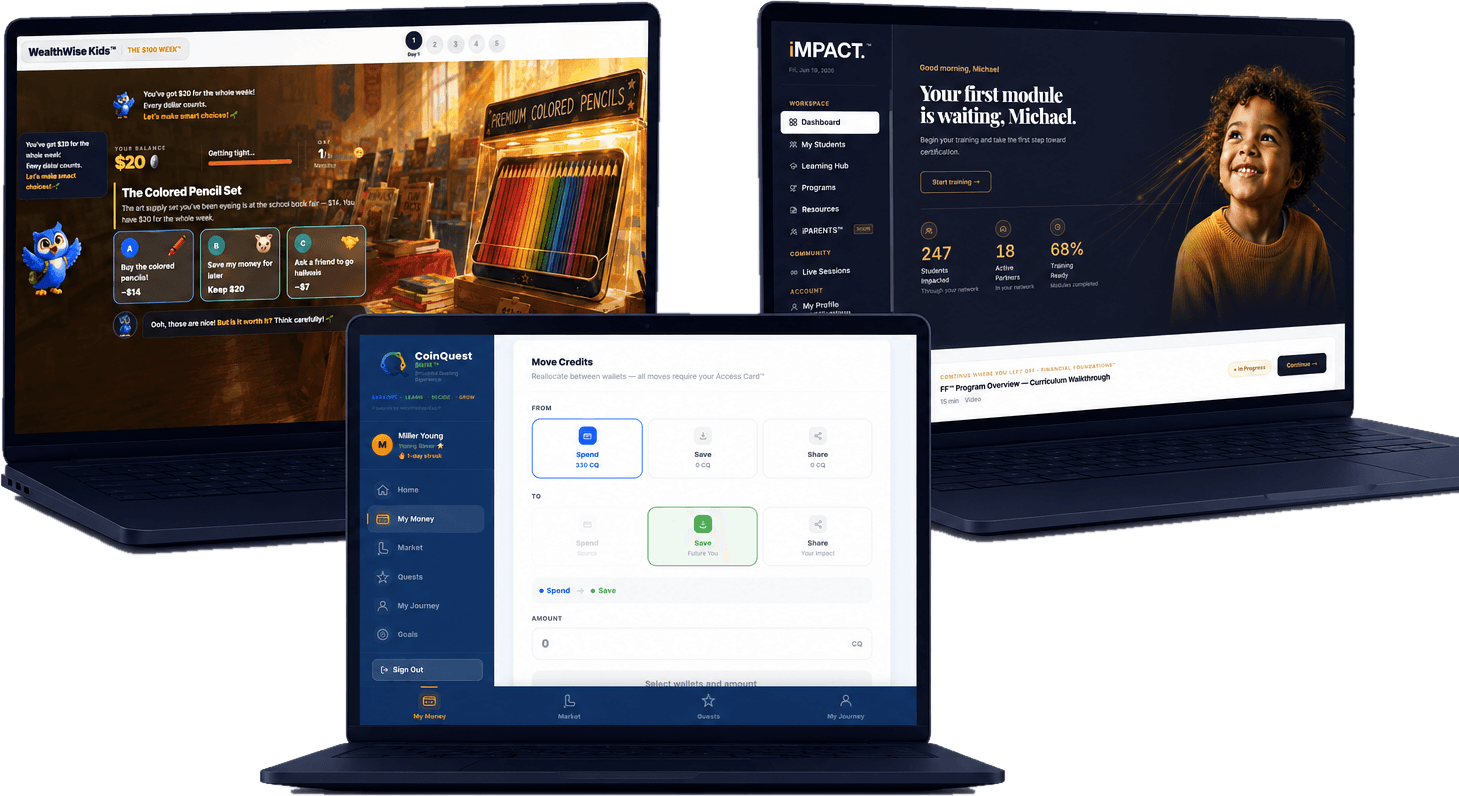

The newsletter
How children learn money. Once a month.
For the adults who teach it, fund it, and live with it. One email, one idea, one thing to try. Reply to unsubscribe; we do it by hand.