

Georgia · Senate Bill 220
Georgia’s personal finance graduation requirement, explained.
Under Senate Bill 220, signed on 28 April 2022, every Georgia school district must require students to complete at least a half-credit course in financial literacy during 11th or 12th grade in order to graduate. The requirement began with the 2024–25 school year. The course follows content standards set by the State Board of Education, may be taught inside an existing course, and counts as a mathematics, social studies or elective credit.
Last reviewed: 13 October 2026. Sources are listed at the end of the page.
What the law says
A half credit, in 11th or 12th grade, for every graduate.
SB 220 added a new section to Georgia’s education code, O.C.G.A. § 20-2-149.4. It does three things a district has to act on. It tells the State Board of Education to adopt content standards for a minimum course in financial literacy. It tells every local board, beginning in 2024–25, to require all students to complete at least a half-credit course built on those standards, during 11th or 12th grade, as a condition of graduation. And it lets that course be taught within existing coursework and count toward a mathematics, social studies or elective credit.
The same bill set rules for who may teach the course and created the Georgia Commission on Civics Education. That second part is about civics, not money, and does not change the course.
The state’s existing high-school economics course had already moved in this direction. In December 2021 the State Board approved a rewrite, now called Personal Finance and Economics (course 45.061). GaDOE’s standards for it include ten personal finance standards: life decisions and paying for them, income and the paystub, a sample Form 1040, budgeting, banking, interest, taxes, credit, insurance, earnings, consumer protection and identity theft.
Timeline
9 Dec 2021
The State Board of Education approves a revised high-school economics course with much more personal finance in it: Personal Finance and Economics.
28 Apr 2022
Governor Kemp signs Senate Bill 220. It adds the half-credit financial literacy requirement to Georgia law.
2022–23
The Personal Finance and Economics standards (course 45.061) take effect.
1 Jan 2023
The law’s deadline for the Professional Standards Commission to set out which teachers may teach the course.
30 Dec 2023
The law’s deadline for the Commission to create a financial literacy teaching endorsement.
2024–25
The graduation requirement begins. Local boards must require the course of all students in 11th or 12th grade.
The 2023 dates are deadlines written into the law. This page does not confirm when each was met.
For district and school leaders
Five things your district decides.
The law sets the floor and leaves the build to each district. These are the decisions curriculum, CTE and social studies leads usually make together.
Which course carries it
The law lets the course sit inside coursework you already offer, as long as it implements the State Board’s standards. Most districts will look first at Personal Finance and Economics, the required half-unit economics course GaDOE rebuilt around personal finance. Others will add a standalone half-credit course. Either way, confirm with GaDOE that the course you choose meets the requirement.
When students take it
The law places the course in 11th or 12th grade. If your economics course sits earlier in the schedule, ask GaDOE how that is treated before you count it toward this requirement.
Which credit it counts as
A mathematics, social studies or elective credit. That choice changes who teaches it and what it displaces in a student’s schedule, so decide it with counselors in the room.
Who teaches it
The law deems teachers appropriately licensed if they hold a renewable secondary certificate in business, economics, mathematics, family and consumer science, or marketing; a special education certificate with social science designations; or the financial literacy endorsement.
What comes before it
Georgia’s social studies standards already teach money from kindergarten: earning income and coins in K, budgets in grades 4 and 5, personal money management in grade 8. A K–8 sequence that follows them makes the high-school course a capstone, not a first introduction.
Where Financial Foundations™ fits
A ready course for the half credit, and the K–8 road to it.
Financial Foundations™ is 266 scripted lessons in four grade bands: K–2, 3–5, 6–8 and 9–12. The 9–12 band is built for a course like Georgia’s: income and taxes, borrowing, credit, investing, insurance, paying for college or trade school, and a plan for the first year on your own. Every lesson is scripted, so a teacher without a finance background can run it.
We have mapped the program to the Georgia social studies standards, code by code. Of Georgia’s 10 high-school personal finance standards, 10 are addressed; of the 25 K–8 economics and personal finance standards we list, 23 are addressed. That crosswalk is our own self-assessment, and it covers the personal finance standards, not the economics units of Personal Finance and Economics. Against the 2021 National Standards for Personal Financial Education, the program addresses 79 of 95, also self-assessed.
In a pilot, we map the lessons to the course your district has chosen, so your team sees exactly which standards each unit carries before anything is bought.
Alongside the lessons, The $100 Week™ is a free five-day browser simulation, and the FLIQ Score™ is an emerging measure of how students make money decisions. It is still being validated, and we make no claim about outcomes.
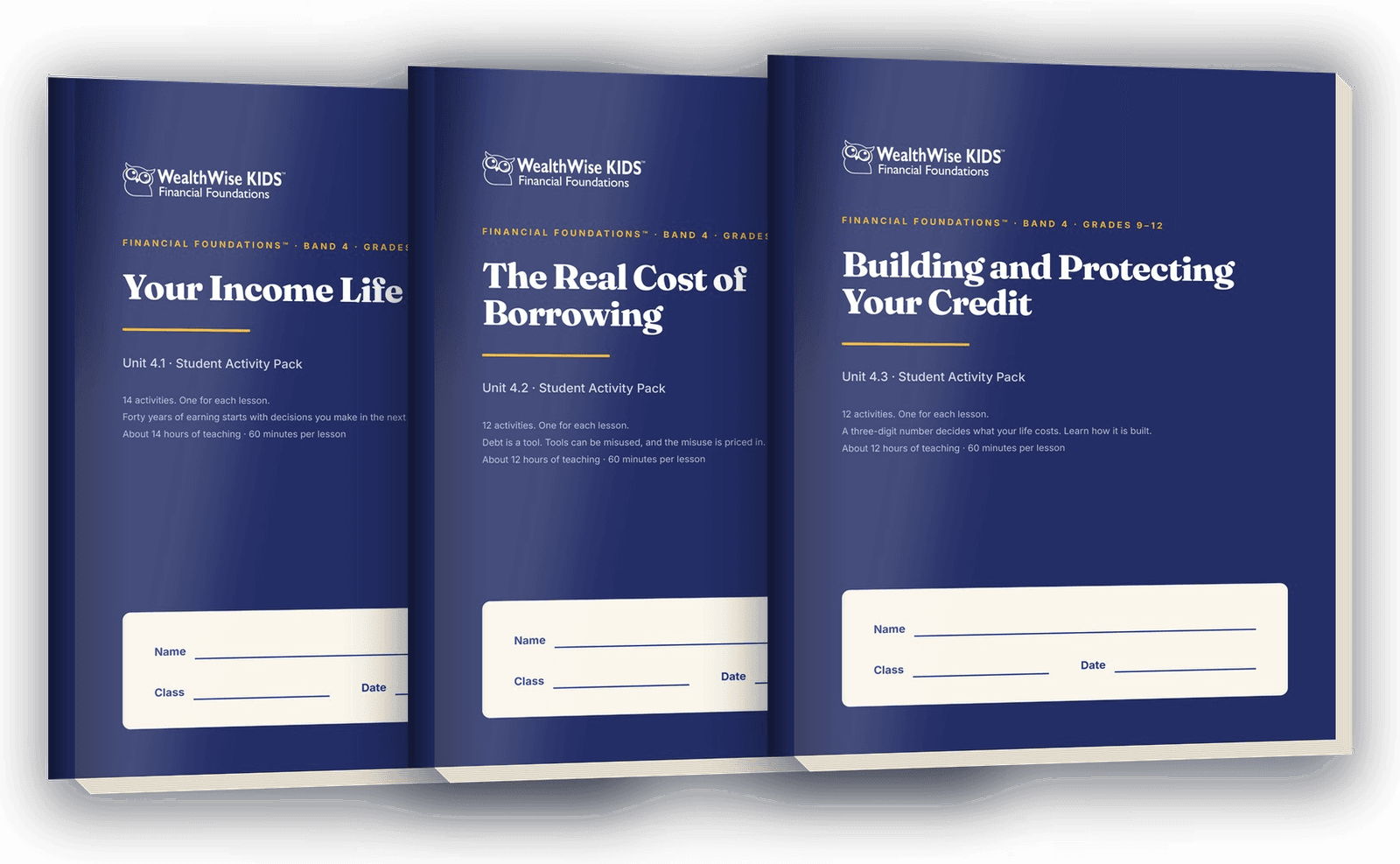
Band 4 · grades 9–12 · Units 4.1 to 4.3
Try it first
A free five-week pilot, before a single purchase order.
One cohort, any grade band, no cost, no contract, no card. A Georgia high school can run part of the 9–12 band alongside its current course and see how the lessons and the class report read. Five weeks is not a growth measure, and we do not present it as one.
Funding for Georgia schools
Paying for it from money already in the plan.
SB 220 itself sets aside no money for the course. Districts commonly fund financial literacy through Title IV-A; your federal-programs office confirms fit. Our Georgia funding guide walks through the usual order of sources and the questions to bring to your coordinator.
Prices are published, from $600 per classroom, and the official price sheet is one page for the PO file.